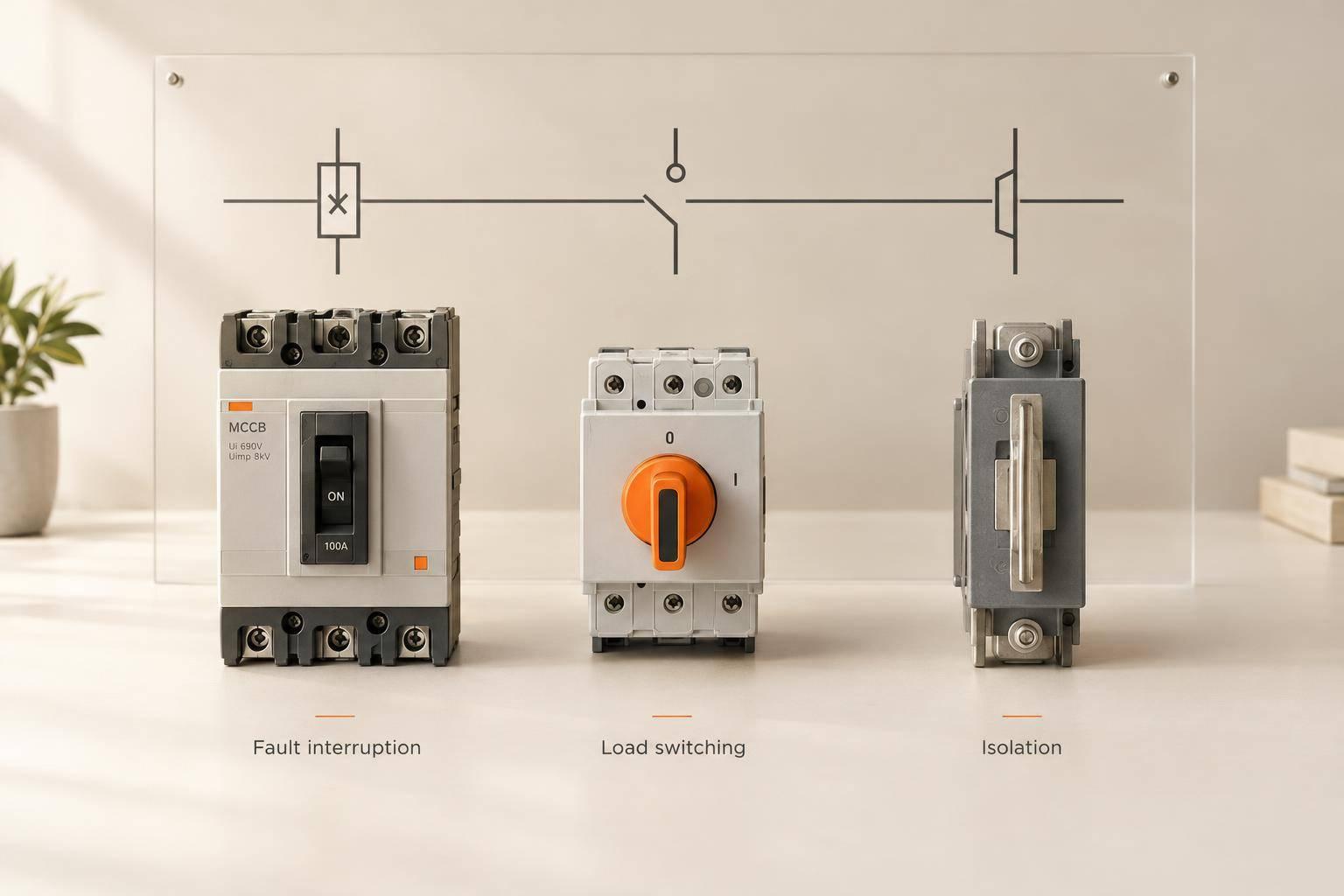
Single-Line Diagram Symbols: Breakers vs. Switches
I check the device’s duty before I price its symbol. A breaker interrupts fault current within its rating. An off-load disconnector provides isolation after current interruption. A load-break switch opens normal load current - not fault current.
Quick Comparison
| What I check | Circuit breaker | Off-load disconnector | Load-break switch |
|---|---|---|---|
| Opens normal load current | Yes | No | Yes, within its rating |
| Interrupts fault current | Yes, within its rating | No | No; needs separate protection |
| Quote details | Trip unit or relays, interrupting rating, accessories | Isolation hardware, locks, interlocks | Switching ratings, fuses if required, interlocks |
On ANSI drawings, 52 identifies an AC circuit breaker, but it doesn’t specify the trip package. That’s why I trace each tag through the legend, equipment schedule, and specification instead of relying on shape alone.
Before bidding, I confirm voltage, current, fault ratings, controls, and accessories - and get conflicts resolved <u>in writing</u>. Whether I use supplier documents or Elora Grid outputs, I check them against the governing documents. The goal is simple: quote the right device and the parts needed to do its job.
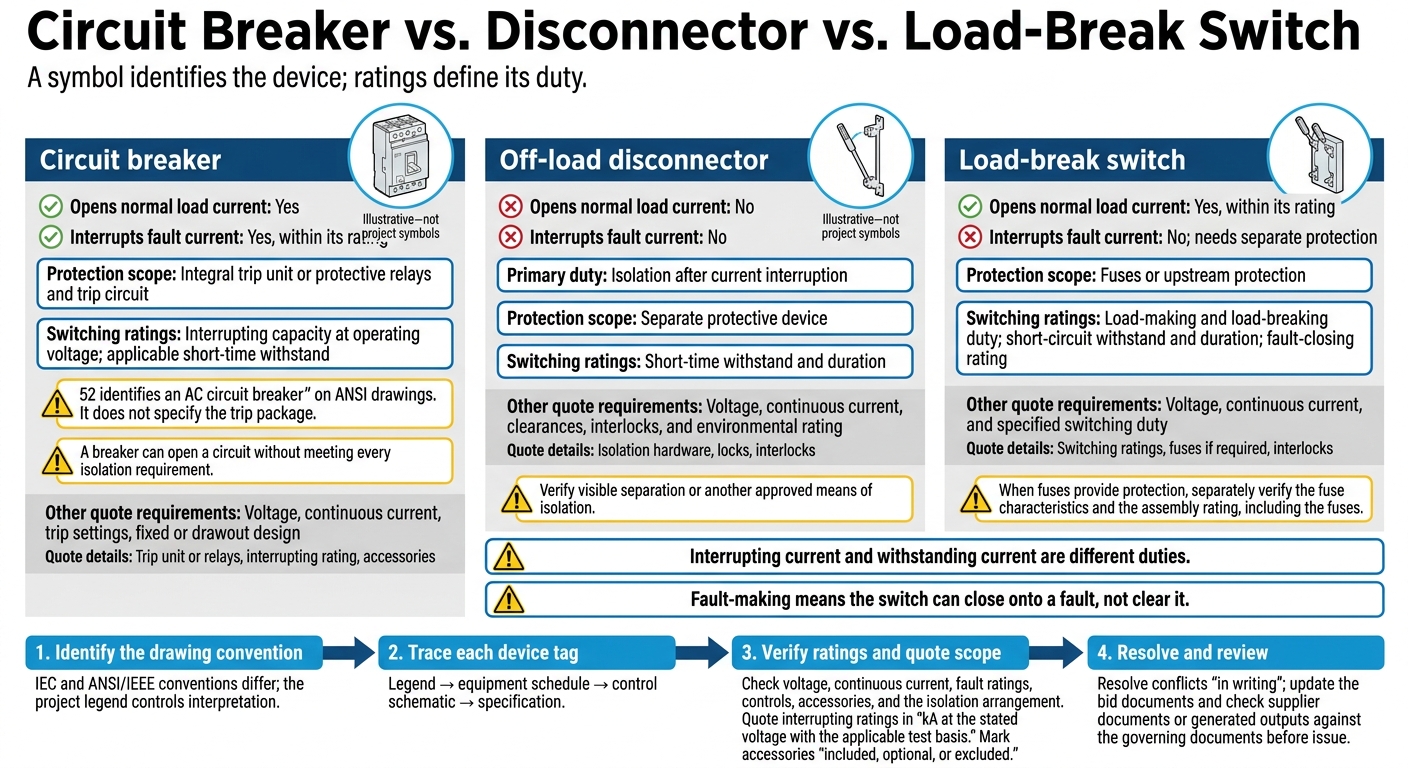
Circuit Breaker vs. Disconnector vs. Load-Break Switch
Single Line Diagram for Substation - Made Simple with Symbols!⭐
sbb-itb-f008923
Circuit Breakers vs. Disconnectors vs. Load-Break Switches
Once a symbol points to a device class, match that class to the switching duty the device must perform.
Interrupting current and withstanding current are different duties. A symbol identifies the likely device class, but ratings and standards define what it can do. Check the named standard and the project schedule.
| Quote check | Circuit breaker | Off-load disconnector | Load-break switch |
|---|---|---|---|
| Symbol clues | Breaker tag, trip note, or 52 on ANSI drawings | Often an openable blade or contact | Often a switch or blade, sometimes with a switching-duty note |
| Protection scope | Integral trip unit or protective relays and trip circuit | Separate protective device | Fuses or upstream protection |
| Switching ratings | Interrupting capacity at operating voltage; applicable short-time withstand | Short-time withstand and duration | Load-making and load-breaking duty; short-circuit withstand and duration; fault-closing rating |
| Other quote requirements | Voltage, continuous current, trip settings, fixed or drawout design | Voltage, continuous current, clearances, interlocks, and environmental rating | Voltage, continuous current, and specified switching duty |
Circuit Breakers: Interrupting Load and Fault Current
On ANSI drawings, 52 identifies an AC breaker - not its trip package. Confirm the integral trip unit or associated relays and trip circuit, and quote the trip unit and interrupting data separately. Specify trip functions and settings separately from the frame rating. A breaker can open a circuit without meeting every isolation requirement.
Disconnectors: Isolation After Current Interruption
A blade symbol doesn't always mean a plain off-load disconnector. An off-load disconnector requires current interruption first; a load-rated disconnect switch adds switching capability. Verify visible separation or another approved means of isolation.
Check locking and suitability for indoor, outdoor, contaminated, wet, or elevated-altitude service. Quote isolation hardware, interlocks, and any fuse base separately. In fused assemblies, the fuses handle interrupting duty, so list both devices in the quote. A grounding switch connects an isolated circuit to ground and needs its own operating sequence and interlocks.
Load-Break Switches: Switching Normal Load Current
For transformer primaries and medium-voltage feeders, quote load-breaking duty and fuse coordination separately. Transformer service also calls for checks of magnetizing-current and inrush duties.
Fault-making means the switch can close onto a fault, not clear it. When fuses provide protection, separately verify the fuse characteristics and the assembly rating, including the fuses. Before pricing, make sure that duty check matches the legend and equipment schedule.
Read Symbols With the Legend and Equipment Schedule
Once you identify the device duty, check the legend to confirm the exact assembly to purchase. Identify the drawing convention before reading the shape. IEC and ANSI/IEEE drawings use different symbol conventions, and the project legend controls how you read them. Orientation and simplified drafting can change a symbol’s shape without changing its duty. Resolve conflicts using the referenced standard.
Map each graphic to its device class using the project legend, then use the table below to define what the quote must include.
| Symbol clue | Legend definition to confirm | Tag or function reference | Schedule requirements | Procurement consequence |
|---|---|---|---|---|
| Breaker graphic | Circuit breaker | ANSI 52 or project tag | Interrupting rating, continuous current, trip unit, voltage, accessories, and construction | Include the specified trip package and accessories |
| Single blade or isolator graphic | Disconnector/isolator | Isolation tag or equipment tag | Ampere and voltage rating, visible break if required, interlocks, auxiliary contacts, fused or non-fused status | Include specified isolation hardware and interlocks |
| Fused switch symbol | Fused switch or fuse-disconnector | Fuse tag and class | Switch rating, fuse class, fuse ampere rating, fuse interrupting rating, spare fuses, blown-fuse indication | Include both the switch and the fuse system |
| Switch-disconnector or load-break marking | Switch rated for normal-load switching | LBS, S-D, or switch-disconnector | Load-break current, voltage, short-circuit withstand, making duty if applicable, operating handle, interlocks, fuses, remote operation | Match the specified switching ratings and operating package |
| Grounding switch symbol | Grounding switch | Grounding-switch tag; interlock reference | Short-circuit making rating, withstand rating, interlocking sequence, position indication, key interlocks | Include the grounding switch and interlock hardware |
| Breaker or switch with auxiliary contacts | Main device plus open/closed/trip contacts | Contact designation and schematic reference | Contact quantity, normal state, voltage, terminal blocks, control wiring, remote indication | Price auxiliary contacts separately when they are not part of the standard package |
The symbol starts the check. The legend, schedule, and specification determine which device to quote.
Verify Device Tags, Ratings, and Switching Duties
Trace each tag through the legend, schedule, control schematic, and specification. Check poles, neutral switching, continuous current, construction, control voltage, and accessories. A tag is a cross-reference, not a complete equipment specification.
Quote interrupting ratings in kA at the stated voltage with the applicable test basis. Check those ratings against the available-fault-current study. Treat any mismatch as a scope issue - not a drafting detail.
Resolve Drawing Conflicts Before Bidding
Read the circuit as a coordinated assembly, not a set of interchangeable symbols. Flag breaker graphics scheduled as disconnects, missing fuses or grounding switches, and mismatched fault levels, control voltages, or operating mechanisms.
In an RFI log, record the affected tag, conflicting document references and revisions, technical risk, and price impact. Request written clarification under the contract’s document-precedence rules. Track unresolved inclusions, exclusions, and allowances. Once clarification arrives, update the one-line markup, schedule, supplier comparison, and bid so they all reflect the same revision.
Turn Device Requirements Into Supplier Quote Scope
Once you’ve interpreted the symbols, define the quote scope before pricing: devices, accessories, testing, and exclusions. A lower-cost substitute isn’t equivalent if it changes fault interruption, isolation, or lockout requirements.
Check Quoted Equipment, Accessories, and Exclusions
Require a numbered quote schedule for each main and feeder device. Include the manufacturer, model, system voltage, continuous current, interrupting rating, and applicable withstand ratings. Each quote must identify both the fault-clearing device and the isolation arrangement.
Mark every accessory included, optional, or excluded. Check trip units or relays, CTs, control power, shunt trips, interlocks, enclosure ratings, and fixed versus drawout construction.
Use the table below to assign scope before accepting a price. Name the responsible party for every line item. For each open clarification, set a response deadline before bid submission.
| Scope item | Quote inclusion | Responsible party | Clarification | Exclusion risk |
|---|---|---|---|---|
| Breaker scope | Breaker, trip unit or relay, CTs, shunt trip, auxiliaries | Supplier / protection engineer | Interrupting rating, trip functions, control voltage | Disconnector substituted; protection omitted |
| Isolation scope | Lockable isolator, position indication, specified grounding and interlocks | Supplier / installer | Isolation method, upstream fault-clearing device | Isolation hardware or position indication omitted |
| Load-break scope | Load-rated switch, required fuses | Supplier | Load-break rating, fuse requirements | Non-load-break isolator substituted; fuses omitted |
| Construction scope | Cradle, shutters, racking hardware, specified enclosure | Supplier | Base-price construction coverage | Fixed equipment or unsuitable enclosure quoted |
| Control scope | Shunt trip, control-power source, terminals, internal wiring | Supplier / installer | Termination points, internal/field wiring boundaries, external power responsibility | Remote-trip function incomplete |
| Field scope | Field assembly, terminations, factory/site tests, reports | Contractor / testing firm / supplier | Activity assignments, witness points, deliverables | Installation, testing, or commissioning excluded |
| Engineering and spare-parts scope | Protection and coordination studies, settings, spare fuses, specified parts | Engineer / study specialist / supplier | Study limits, spare quantities, delivery milestones | Settings or required spares omitted |
Prepare Bid Outputs for Review With Elora Grid
Use the drawing set to trace each symbol to a supplier line item, then check each line item for exclusions.
Upload tender drawings and related documents to Elora Grid to generate single-line diagrams, 2D and 3D general arrangements, and schematics for bid and design packages. Use these outputs to trace each device tag to its drawing location, schedule entry, rating, inquiry line, and exclusion.
Review all generated outputs against the governing documents before issue.
Conclusion: Select by Electrical Duty, Not Symbol Shape
A symbol identifies the device; ratings define its duty. Breakers interrupt rated fault current. Disconnectors provide isolation after interruption. Load-break switches carry and switch normal load current. The ability to make a fault circuit does not mean a device can interrupt fault current.
That distinction determines the quote. Before bidding, check that the legend, equipment schedule, protection requirements, and supplier scope agree. Confirm the applicable NFPA 70 edition, local amendments, and product standards. Resolve conflicts in device type and ratings in writing, rather than relying on assumptions.
FAQs
Can a circuit breaker also serve as a disconnect?
Only if it meets the specific design standards for isolation. A circuit breaker interrupts a circuit, including fault currents. A disconnector provides electrical isolation.
Stopping power flow alone doesn't meet a disconnector’s safety isolation requirements. So, a circuit breaker typically can't replace a disconnector unless it also meets those standards.
When can a fused switch replace a breaker?
The supplied documentation does not state when a fused switch can replace a circuit breaker. A fused switch protects against overcurrent by melting its fuse link to interrupt the circuit. A circuit breaker is a switching device with a specified ability to interrupt fault current.
How should unresolved device ratings affect my bid?
Unresolved device ratings leave gaps in scope. Don’t quietly read conflicts in your favor - you could face change costs you can’t recover after the contract is awarded. Record every conflict in a register and request formal clarification from the client.
Before submitting your bid, use Elora Grid to check for mismatches across the single-line diagram, specification, and equipment list. If the client provides no direction, your team must set a calculated allowance for any remaining ambiguities.