BAT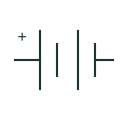
Battery
An electrochemical electrical source or storage element represented in a circuit.
SLD / Schematic
A battery bank with a mid-point connection that provides positive and negative rails about a common centre point.
In plain English
A centre-tapped battery bank brings out a connection at the middle of the series chain, giving positive and negative rails referred to that point. It is used in some UPS rectifier-inverter designs, three-level converters and telecom or substation DC systems that need a symmetric supply or a defined midpoint for earth-fault detection.
Drawings show the battery symbol split into two halves with a lead taken from the junction, often labelled N, M or 0 V. The midpoint may be earthed, earthed through a resistance or left floating with an insulation monitor, and the drawing should state which.
The symbol does not show how the two halves are kept balanced. Unequal loading on the two rails discharges one half faster, and the midpoint earthing method changes how an earth fault on either rail behaves.
A battery bank with a mid-point connection that provides positive and negative rails about a common centre point. A centre-tapped bank has a usable midpoint; an ordinary battery string presents only positive and negative terminals.
Read the source: IEC graphical symbols for diagrams · Multilevel NPC converter application context
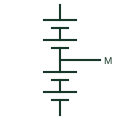
A centre-tapped battery bank brings out a connection at the middle of the series chain, giving positive and negative rails referred to that point. It is used in some UPS rectifier-inverter designs, three-level converters and telecom or substation DC systems that need a symmetric supply or a defined midpoint for earth-fault detection.
Drawings show the battery symbol split into two halves with a lead taken from the junction, often labelled N, M or 0 V. The midpoint may be earthed, earthed through a resistance or left floating with an insulation monitor, and the drawing should state which.
The symbol does not show how the two halves are kept balanced. Unequal loading on the two rails discharges one half faster, and the midpoint earthing method changes how an earth fault on either rail behaves.
A centre-tapped bank has a usable midpoint; an ordinary battery string presents only positive and negative terminals.
These public references support the explanation and provide further detail. Their graphics and downloadable files remain with their publishers.
IEC graphical symbol context for batteries.
Public three-level converter context requiring a DC midpoint.
This illustration was authored independently by Elora Grid to explain the concept. It is not reproduced from a customer drawing, an official standard graphic or a manufacturer CAD file. Its correspondence to an exact IEC or IEEE symbol identifier has not been certified.
SVG and DXF downloads contain this original artwork. DXF uses unscaled drawing units; a GA envelope supplies no product dimensions, clearances or fabrication information. Original artwork is available under CC BY 4.0. Third-party references retain their own terms.
An electrochemical electrical source or storage element represented in a circuit.
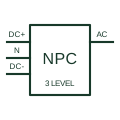
A multilevel switching arrangement using the documented split DC link and neutral-point clamping paths.
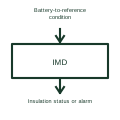
An insulation monitoring function assesses the electrical insulation between the monitored circuit and its reference structure.
Elora Grid helps electrical teams work with drawings, specifications and equipment information. Explore the drafting workflow or join the early-access waitlist.