UGC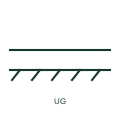
Underground cable
A cable route marked as buried in the ground, distinguishing direct-buried or ducted sections from overhead lines.
IEC
A line or route mark identifying conductors carried overhead on poles or towers rather than buried or enclosed.
In plain English
The overhead line form identifies a circuit section strung in air between supports. On network single-line diagrams it distinguishes overhead feeders from underground cable sections, which matters because the two have different impedance, fault behaviour, auto-reclose practice and lightning exposure.
The symbol does not tell you the conductor type, span lengths, earth wire arrangement or structure type. Line data sheets and route drawings carry those. Where a feeder changes from overhead to underground, look for a cable sealing end or transition point drawn at the junction.
Note where the feeder changes between overhead and underground sections. Check whether auto-reclose is applied to feeders with overhead sections. An overhead line is strung in air; an underground cable is buried and has very different capacitance and fault characteristics.
A line or route mark identifying conductors carried overhead on poles or towers rather than buried or enclosed. An overhead line is strung in air; an underground cable is buried and has very different capacitance and fault characteristics.
Read the source: IEC-60617 symbol preview directory · Building protection system
Independent IEC-context illustration; not certified IEC geometry.
Shown as an independently authored educational illustration. Use the cited publication and drawing legend to verify the required drafting form.
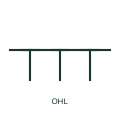
The overhead line form identifies a circuit section strung in air between supports. On network single-line diagrams it distinguishes overhead feeders from underground cable sections, which matters because the two have different impedance, fault behaviour, auto-reclose practice and lightning exposure.
The symbol does not tell you the conductor type, span lengths, earth wire arrangement or structure type. Line data sheets and route drawings carry those. Where a feeder changes from overhead to underground, look for a cable sealing end or transition point drawn at the junction.
An overhead line is strung in air; an underground cable is buried and has very different capacitance and fault characteristics.
These public references support the explanation and provide further detail. Their graphics and downloadable files remain with their publishers.
Public directory of IEC-oriented symbol families.
Public installation-guide context on lightning exposure of external conductors.
This illustration was authored independently by Elora Grid to explain the concept. It is not reproduced from a customer drawing, an official standard graphic or a manufacturer CAD file. Its correspondence to an exact IEC or IEEE symbol identifier has not been certified.
SVG and DXF downloads contain this original artwork. DXF uses unscaled drawing units; a GA envelope supplies no product dimensions, clearances or fabrication information. Original artwork is available under CC BY 4.0. Third-party references retain their own terms.
A cable route marked as buried in the ground, distinguishing direct-buried or ducted sections from overhead lines.
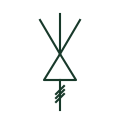
A cable termination where a multicore cable is sealed and its cores separated out to individual phase connections.
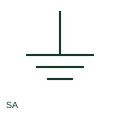
A surge arrester diverts a documented surge-related current through its protective path.
Elora Grid helps electrical teams work with drawings, specifications and equipment information. Explore the drafting workflow or join the early-access waitlist.