PIR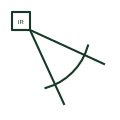
Intruder motion detector plan symbol
Security plan symbol for a passive infrared or dual-technology motion detector reporting to an intruder alarm.
IEC
Plan mark for a ceiling or wall sensor that switches lighting automatically according to occupancy.
In plain English
Lighting presence detectors switch or dim luminaires according to occupancy, usually by passive infrared or microwave sensing. Plans show a small circle or square with a detection mark, often with the coverage radius drawn so designers can check the area is covered.
The plan should also show whether the detector operates in presence mode (automatic on and off) or absence mode (manual on, automatic off) and whether it includes a daylight sensor. These settings strongly affect energy performance and are often stated in a lighting control schedule.
This lighting sensor is distinct from an intruder alarm motion detector even when the sensing principle is the same. The two belong to different systems with different wiring and standards.
Plan mark for a ceiling or wall sensor that switches lighting automatically according to occupancy. An intruder motion detector reports to an alarm panel; a lighting presence detector controls luminaires.
Read the source: IEC graphical symbols for diagrams · Autodesk IEC-60617 preview: Radiation qualifiers
IEC 60617 installation-plan style (architectural and topographical installation symbols); independently drawn, not certified IEC geometry or a database identifier.
Shown as an independently authored educational illustration. Use the cited publication and drawing legend to verify the required drafting form.

Lighting presence detectors switch or dim luminaires according to occupancy, usually by passive infrared or microwave sensing. Plans show a small circle or square with a detection mark, often with the coverage radius drawn so designers can check the area is covered.
The plan should also show whether the detector operates in presence mode (automatic on and off) or absence mode (manual on, automatic off) and whether it includes a daylight sensor. These settings strongly affect energy performance and are often stated in a lighting control schedule.
This lighting sensor is distinct from an intruder alarm motion detector even when the sensing principle is the same. The two belong to different systems with different wiring and standards.
An intruder motion detector reports to an alarm panel; a lighting presence detector controls luminaires.
These public references support the explanation and provide further detail. Their graphics and downloadable files remain with their publishers.
IEC graphical symbol context; independently drawn here.
Public IEC-oriented radiation qualifiers relevant to infrared sensing marks.
This illustration was authored independently by Elora Grid to explain the concept. It is not reproduced from a customer drawing, an official standard graphic or a manufacturer CAD file. Its correspondence to an exact IEC or IEEE symbol identifier has not been certified.
SVG and DXF downloads contain this original artwork. DXF uses unscaled drawing units; a GA envelope supplies no product dimensions, clearances or fabrication information. Original artwork is available under CC BY 4.0. Third-party references retain their own terms.
Security plan symbol for a passive infrared or dual-technology motion detector reporting to an intruder alarm.

General installation plan symbol for a luminaire or lighting point, drawn as a crossed circle at the ceiling position.
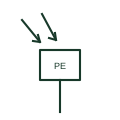
Plan mark for a light-sensitive switch that turns external or perimeter lighting on at dusk and off at dawn.
Elora Grid helps electrical teams work with drawings, specifications and equipment information. Explore the drafting workflow or join the early-access waitlist.