ENC-PRI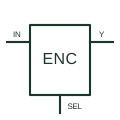
Priority encoder
Encodes the highest-priority qualifying input into the specified binary output word.
Schematic
IEC coder marked HPRI/BIN that outputs the binary number of the highest-priority active input.
In plain English
A priority encoder is shown as an X/Y coder with the additional drawing mark HPRI/BIN: highest priority in, binary out. Inputs are numbered by priority, and outputs carry binary weights. Additional outputs often signal that any input is active, which lets stages be cascaded.
On control drawings priority encoders reduce many alarm or request lines to a code, for example to identify the most important active fault for display. The input numbering must match the intended priority order.
The symbol does not state whether inputs are latched. If the encoder input is a momentary event, a latch stage is needed before it.
IEC coder marked HPRI/BIN that outputs the binary number of the highest-priority active input. A plain binary encoder assumes only one input active; HPRI resolves multiple active inputs.
Read the source: Overview of IEEE Standard 91-1984: explanation of logic symbols (SDYZ001A) · SN74HC148 — priority encoding
Qualifying-symbol and dependency conventions as explained in TI's public overview of IEEE Std 91-1984, which incorporates IEC 617-12 work. Independent educational drawing; not certified IEC geometry or an IEC database identifier. The counterpart is the matching functional concept; no equivalence of every detailed standard graphic is asserted.
Shown as an independently authored educational illustration. Use the cited publication and drawing legend to verify the required drafting form.
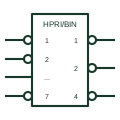
A priority encoder is shown as an X/Y coder with the qualifier HPRI/BIN: highest priority in, binary out. Inputs are numbered by priority, and outputs carry binary weights. Additional outputs often signal that any input is active, which lets stages be cascaded.
On control drawings priority encoders reduce many alarm or request lines to a code, for example to identify the most important active fault for display. The input numbering must match the intended priority order.
The symbol does not state whether inputs are latched. If the encoder input is a momentary event, a latch stage is needed before it.
A plain binary encoder assumes only one input active; HPRI resolves multiple active inputs.
These public references support the explanation and provide further detail. Their graphics and downloadable files remain with their publishers.
Coder qualifiers, including code designations.
Priority encoder documentation.
This illustration was authored independently by Elora Grid to explain the concept. It is not reproduced from a customer drawing, an official standard graphic or a manufacturer CAD file. Its correspondence to an exact IEC or IEEE symbol identifier has not been certified.
SVG and DXF downloads contain this original artwork. DXF uses unscaled drawing units; a GA envelope supplies no product dimensions, clearances or fabrication information. Original artwork is available under CC BY 4.0. Third-party references retain their own terms.
Encodes the highest-priority qualifying input into the specified binary output word.
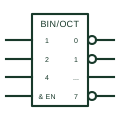
IEC coder marked BIN/OCT or similar, converting a binary input code into one active output.
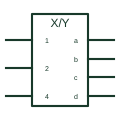
IEC element marked X/Y, the general coder converting one code, named X, into another, named Y.
Elora Grid helps electrical teams work with drawings, specifications and equipment information. Explore the drafting workflow or join the early-access waitlist.