UPS VI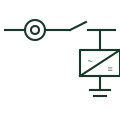
Line-interactive UPS
A UPS that passes mains to the load through a voltage-correcting stage and switches to its bidirectional inverter on failure.
SLD
A UPS that passes raw mains straight to the load and starts its inverter only when mains is lost.
In plain English
An offline or standby UPS connects the load directly to mains through a transfer relay. A separate charger keeps the battery topped up, and the inverter starts only when mains fails, at which point the relay transfers the load. Transfer typically takes several milliseconds to around ten milliseconds.
Drawings show the mains path through a changeover contact to the output, with the charger, battery and inverter forming a parallel branch that connects to the other contact position. These units are mainly small desktop or control panel units.
The load sees mains disturbances and the transfer gap, and the inverter waveform may be stepped rather than sinusoidal. The symbol does not show waveform quality, transfer time or whether surge filtering is included.
A UPS that passes raw mains straight to the load and starts its inverter only when mains is lost. An offline UPS gives no correction until it transfers; an online UPS conditions the output continuously.
Read the source: DC UPS, AC UPS and capacitor buffer modules · DIN-rail power supply, buffer, redundancy and UPS families
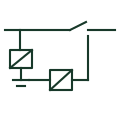
An offline or standby UPS connects the load directly to mains through a transfer relay. A separate charger keeps the battery topped up, and the inverter starts only when mains fails, at which point the relay transfers the load. Transfer typically takes several milliseconds to around ten milliseconds.
Drawings show the mains path through a changeover contact to the output, with the charger, battery and inverter forming a parallel branch that connects to the other contact position. These units are mainly small desktop or control panel units.
The load sees mains disturbances and the transfer gap, and the inverter waveform may be stepped rather than sinusoidal. The symbol does not show waveform quality, transfer time or whether surge filtering is included.
An offline UPS gives no correction until it transfers; an online UPS conditions the output continuously.
These public references support the explanation and provide further detail. Their graphics and downloadable files remain with their publishers.
Public UPS function context.
Public DIN-rail UPS family context.
This illustration was authored independently by Elora Grid to explain the concept. It is not reproduced from a customer drawing, an official standard graphic or a manufacturer CAD file. Its correspondence to an exact IEC or IEEE symbol identifier has not been certified.
SVG and DXF downloads contain this original artwork. DXF uses unscaled drawing units; a GA envelope supplies no product dimensions, clearances or fabrication information. Original artwork is available under CC BY 4.0. Third-party references retain their own terms.
A UPS that passes mains to the load through a voltage-correcting stage and switches to its bidirectional inverter on failure.
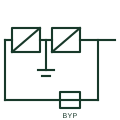
A UPS whose rectifier and inverter carry the load continuously, with the battery on the DC link and a static bypass.
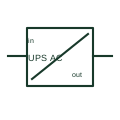
An AC UPS provides a documented AC load supply through its normal and backup operating arrangements.
Elora Grid helps electrical teams work with drawings, specifications and equipment information. Explore the drafting workflow or join the early-access waitlist.