COMB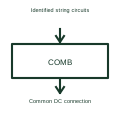
Photovoltaic string combiner
A string combiner brings identified solar DC circuits together at a defined connection arrangement.
Schematic
A large solar inverter fed from DC combiner boxes, usually paired with its own medium-voltage transformer.
In plain English
A central inverter converts the combined output of many PV strings at a single location. Strings are first paralleled in DC combiner boxes, which feed DC recombiners and then the inverter. Ratings run from several hundred kilowatts to several megawatts, and the inverter usually sits in a skid with a medium-voltage step-up transformer and switchgear.
Single-line diagrams show the DC combiner network converging on one inverter block, the inverter output to a low-voltage winding of the skid transformer, and the medium-voltage ring main unit. Dual inverters sharing one three-winding transformer are also common.
A central inverter fault takes a large part of the plant offline, and the DC cabling distances are long. The symbol does not show DC earthing arrangement or insulation monitoring, which differ between plants and must be stated separately.
A large solar inverter fed from DC combiner boxes, usually paired with its own medium-voltage transformer. A central inverter collects many combined strings; a string inverter connects a few strings directly.
Read the source: Photovoltaic technology and inverter functions · Solar string combiner functions
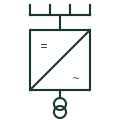
A central inverter converts the combined output of many PV strings at a single location. Strings are first paralleled in DC combiner boxes, which feed DC recombiners and then the inverter. Ratings run from several hundred kilowatts to several megawatts, and the inverter usually sits in a skid with a medium-voltage step-up transformer and switchgear.
Single-line diagrams show the DC combiner network converging on one inverter block, the inverter output to a low-voltage winding of the skid transformer, and the medium-voltage ring main unit. Dual inverters sharing one three-winding transformer are also common.
A central inverter fault takes a large part of the plant offline, and the DC cabling distances are long. The symbol does not show DC earthing arrangement or insulation monitoring, which differ between plants and must be stated separately.
A central inverter collects many combined strings; a string inverter connects a few strings directly.
These public references support the explanation and provide further detail. Their graphics and downloadable files remain with their publishers.
Public photovoltaic inverter function context.
Public solar string combiner function context.
This illustration was authored independently by Elora Grid to explain the concept. It is not reproduced from a customer drawing, an official standard graphic or a manufacturer CAD file. Its correspondence to an exact IEC or IEEE symbol identifier has not been certified.
SVG and DXF downloads contain this original artwork. DXF uses unscaled drawing units; a GA envelope supplies no product dimensions, clearances or fabrication information. Original artwork is available under CC BY 4.0. Third-party references retain their own terms.
A string combiner brings identified solar DC circuits together at a defined connection arrangement.
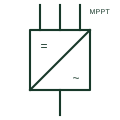
A solar inverter connecting a small number of PV strings directly, each group tracked by its own MPPT input.
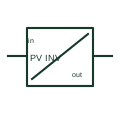
A photovoltaic inverter converts a documented PV DC input into an AC output and provides the selected PV control functions.
A PV inverter converts the selected array DC power to its specified AC interface.
Elora Grid helps electrical teams work with drawings, specifications and equipment information. Explore the drafting workflow or join the early-access waitlist.