*
Integrating instrument general symbol
General rectangle-with-band form for instruments that totalise a quantity over time, such as energy meters.
SLD / Schematic
Integrating meter that totalises the square of voltage over time, used to assess voltage-dependent losses and stress.
In plain English
A volt-squared-hour meter integrates the square of voltage over time. Quantities such as iron losses in transformers and the stress on some insulation vary roughly with voltage squared, so the register gives a measure of exposure that a simple time-at-voltage record would not.
It is uncommon on modern drawings and is often provided as a calculated register inside a multifunction meter. The symbol does not tell you the reference voltage or whether the value is per phase or combined, so the meter documentation is needed to use the reading.
Check whether the value is per phase or combined. Confirm whether this is a separate meter or a calculated register. A V²h meter integrates voltage squared; a kWh meter integrates power.
Integrating meter that totalises the square of voltage over time, used to assess voltage-dependent losses and stress. A V²h meter integrates voltage squared; a kWh meter integrates power.
Read the source: IEC graphical symbols for diagrams
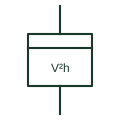
A volt-squared-hour meter integrates the square of voltage over time. Quantities such as iron losses in transformers and the stress on some insulation vary roughly with voltage squared, so the register gives a measure of exposure that a simple time-at-voltage record would not.
It is uncommon on modern drawings and is often provided as a calculated register inside a multifunction meter. The symbol does not tell you the reference voltage or whether the value is per phase or combined, so the meter documentation is needed to use the reading.
A V²h meter integrates voltage squared; a kWh meter integrates power.
These public references support the explanation and provide further detail. Their graphics and downloadable files remain with their publishers.
IEC context for graphical symbols used in diagrams; no IEC graphic is reproduced.
This illustration was authored independently by Elora Grid to explain the concept. It is not reproduced from a customer drawing, an official standard graphic or a manufacturer CAD file. Its correspondence to an exact IEC or IEEE symbol identifier has not been certified.
SVG and DXF downloads contain this original artwork. DXF uses unscaled drawing units; a GA envelope supplies no product dimensions, clearances or fabrication information. Original artwork is available under CC BY 4.0. Third-party references retain their own terms.
General rectangle-with-band form for instruments that totalise a quantity over time, such as energy meters.
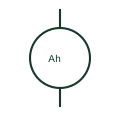
An ampere-hour meter integrates current over time for a documented measurement purpose.
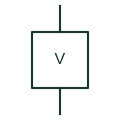
Recording instrument that keeps a time record of voltage, drawn as a square marked V.
Elora Grid helps electrical teams work with drawings, specifications and equipment information. Explore the drafting workflow or join the early-access waitlist.