How to Compare Electrical Quotes with Different Scopes
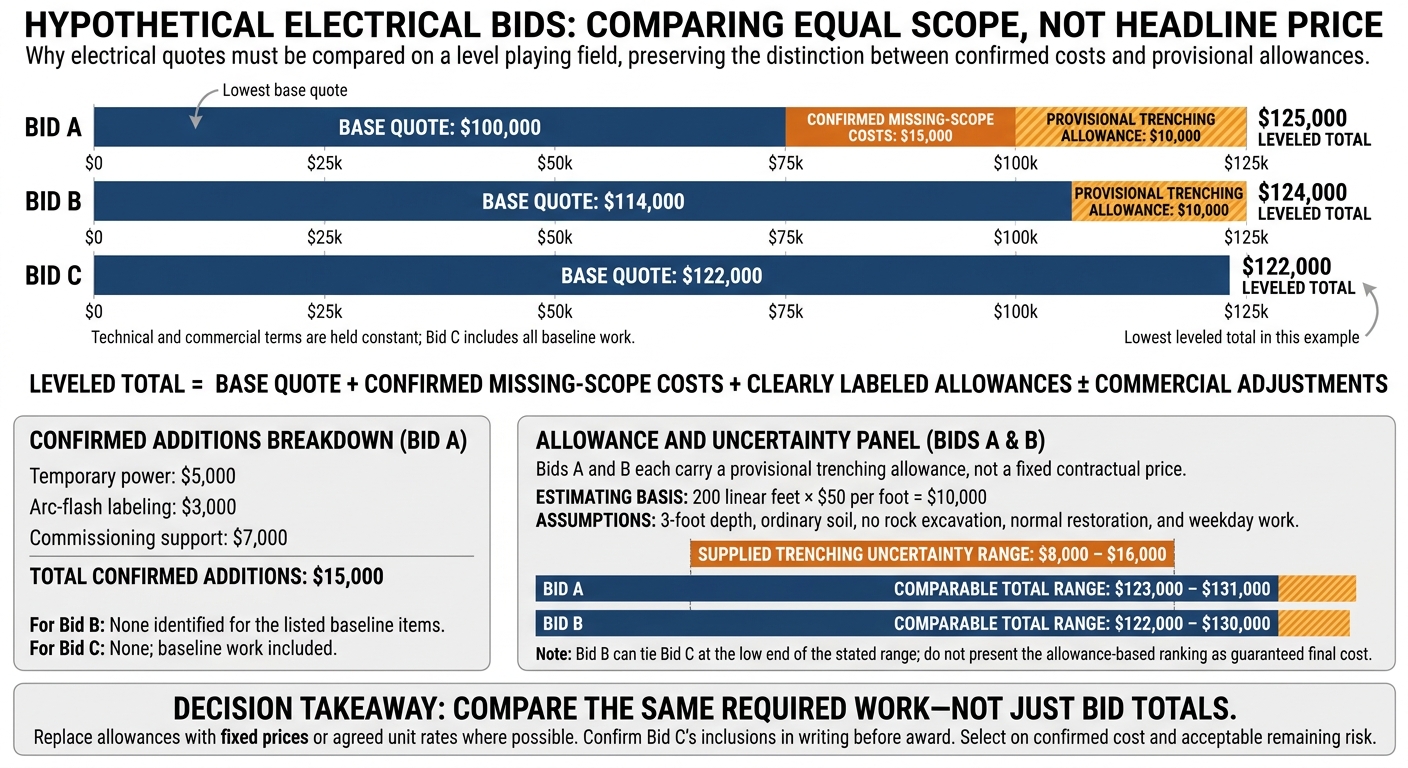
Compare electrical quotes by pricing the same required work - not just comparing bid totals. Start with the same drawings, specifications, and commercial terms, then add confirmed missing costs and clearly labeled allowances. In the article’s hypothetical example, a $100,000 bid becomes $125,000 after adjustments, making a $122,000 bid the lower-cost option.
Check each quote for:
- Equipment: Quantities, ratings, required documents, and substitutions.
- Installation: Labor, materials, permits, temporary power, shutdowns, and handoffs between contractors.
- Testing and turnover: Factory tests, field testing, commissioning, training, and final records.
- Cost and risk: Exclusions, taxes, freight, payment terms, delivery dates, and uncertain costs.
Get scope commitments in writing before award. Choose based on the confirmed cost of the required work and acceptable remaining risk, not the lowest headline price.
Electrical Quote Comparison: Base Price vs. Leveled Cost
What Is Bid Leveling?
sbb-itb-f008923
2. Check Equipment and Installation Scope
Use the comparison matrix to check every equipment tag, installation package, and interface against the issued drawings and specifications.
Check Equipment Ratings and Engineering Documents
Check each equipment tag against the one-line diagram, equipment schedule, and specification. Every mismatch is a scope gap that needs a price, clarification, or assigned responsibility.
Record each rating on its own line: voltage, frequency, phase, continuous current, bus rating, interrupting rating, short-circuit rating, withstand rating, and protection scheme. These ratings are not interchangeable. Equipment that interrupts fault current needs an interrupting rating at least equal to the available fault current at the system voltage.
Also check enclosure suitability, dimensions, access clearances, cable entry, metering, relays, communications, accessories, spare capacity, shipping splits, and field assembly as separate items.
Check for missing equipment-specific calculations, shop drawings, wiring diagrams, coordination and arc-flash inputs, installation instructions, and final protection settings. IP and NEMA ratings are not equivalent. Compare the specified enclosure type and environmental protection directly with the offered type.
| Requirement | Supplier offering | Deviation | Commercial impact | Reviewer | Resolution status |
|---|---|---|---|---|---|
| Specified enclosure type | Record exact type and material | Identify environmental protection differences | Add confirmed upgrade cost or price allowance | Electrical engineer | Open |
| Required fault-duty ratings | Record ratings at system voltage | Flag missing or inadequate ratings | Equipment acceptability and price cannot be confirmed | Electrical engineer | Open |
| Required engineering documents | Record included deliverables | Identify missing calculations or settings | Add required document preparation cost | Owner/engineer | Open |
Divide Installation into Priced Work Packages
Require separate prices or clearly identified quantities for these work packages:
- Mobilization
- Demolition and civil work
- Raceways and cabling
- Grounding and terminations
- Testing and closeout
- Permits, inspections, and utility coordination
For each package, record the quantity, unit basis, assumed productivity, material specification, labor basis, and exclusions.
Confirm route lengths, soil and rock conditions, existing underground utilities, crane and delivery access, and laydown space. Check working hours, outage windows, energized-work restrictions, weather exposure, and hazardous or classified locations. Include demolition requirements, temporary power, and restoration.
For owner-furnished equipment, treat receiving, setting, anchoring, and connecting as separate tasks.
“Installation complete” is not a priced work package.
Assign Responsibility for Each Interface
Mark every handoff on the drawings. Assign who supplies, installs, connects, tests, and pays for each interface.
Separate equipment-end and source-end terminations. Account for lugs, glands, torque data, control wiring, network configuration, and shutdown authorization. Before comparing totals, use the table to close each handoff gap and replace every open decision with a written agreement.
| Responsible party | Included work to confirm | Excluded work to identify | Required input | Unresolved decision |
|---|---|---|---|---|
| Owner | Design criteria, outage authorization, owner-furnished equipment | Unstated field labor unless listed | Approved load list and equipment locations | Who pays for owner-furnished equipment damage during unloading? |
| Electrical contractor | Conduit, cable, grounding, terminations, labeling, testing | Civil excavation or equipment supply unless priced | Released drawings and access | Are final feeder lengths based on surveyed routes? |
| Equipment supplier | Equipment, factory drawings, factory testing, settings support | Field rigging, installation, or startup unless listed | Approved submittals and utility requirements | Who performs field relay programming? |
| Civil contractor | Pads, trenches, duct banks, backfill, restoration | Electrical conductors and terminations | Equipment loads and coordinates | Is rock excavation included? |
| Mechanical contractor | Motor or packaged-equipment connections within its package | Upstream feeders and protection | Motor data and equipment readiness | Who supplies local disconnects? |
| Utility | Service requirements, meter, inspection, energization | Customer-side construction unless stated | Load data, applications, and easements | Which fees and utility-installed items are included? |
For the U.S. compliance check, identify the authority having jurisdiction (AHJ), adopted National Electrical Code provisions, listing and labeling requirements, permits, and inspections. Listed or labeled equipment must be installed and used according to its applicable instructions.
In U.S. documents, use grounding, not earthing. Do not treat the technical or regulatory requirements as equivalent.
With equipment and installation scope priced, the next step separates factory tests from field commissioning.
3. Compare Testing, Commissioning, and Turnover
Separate Factory Tests from Field Commissioning
Build the testing schedule around project specifications and equipment requirements, not a bidder’s standard package. Give every bidder the same test list so price differences reflect scope - not wording.
Separate factory acceptance testing (FAT), delivery inspection, installation checks, field acceptance tests, functional and interlock tests, commissioning/startup, energization support, and post-startup corrections and retesting. Acceptance testing checks readiness for energization. Commissioning checks the completed system against the owner’s requirements and design basis.
For FAT, confirm that the quote covers planning, test procedures, manufacturer attendance, witness testing, test equipment, reports, punch-list resolution, and retesting after failures. For field work, list inspections, torque verification, continuity and insulation-resistance testing, grounding and bonding checks, transformer and circuit-breaker testing, protective-relay testing, functional and interlock tests, motor rotation, communication checks, and thermographic surveys where required. Keep studies and labels separate from testing outputs.
Require bidders to mark every activity included, separately priced, allowance, or excluded. They must also name who provides qualified technicians, calibrated instruments, specialist attendance, settings files, and reports - and who authorizes switching, corrects deficiencies, and pays for retesting. Request extra-visit rates and state the included mobilizations, shifts, standby hours, energization events, and training hours. A blank response is still an unresolved gap.
List Deliverables and Acceptance Requirements
Use one deliverable register alongside the pricing matrix to compare every bidder against the same turnover scope. In each supplier column, record coverage status and any separate price or allowance. Name the responsible party; don’t assume the equipment supplier or installer owns the whole package. Use the register to price missing tests, documents, and retests before comparing bid totals.
| Scope category | Coverage to record | Responsible party | Acceptance requirement |
|---|---|---|---|
| Equipment supply | FAT procedures, witness attendance, reports, correction and retesting | Equipment supplier; owner or engineer reviews | Required factory tests passed and reports accepted before shipment |
| Installation | Delivery inspections, installation checklists, deficiency records | Receiving party and installing contractor | Records identify equipment, condition, and resolved installation defects |
| Testing | Equipment quantities, test methods, specified limits, witness points, and insulation, continuity, grounding, and protection-test reports | Testing contractor; designated engineer reviews | Results meet specified procedures, limits, and manufacturer tolerances |
| Commissioning | Functional and interlock records, energization support, retests, training | Commissioning lead, specialists, and owner’s authorized personnel | Required sequences demonstrated; deficiencies closed or formally accepted |
| Closeout documents | Drawings for approval, calculations, settings files, studies, labels, spare-parts lists, O&M manuals, warranties, as-builts | Named author for each document; designated reviewer | Final documents match installed equipment and accepted settings |
For each deliverable, set a due date, file format, reviewer, review cycles, and acceptance condition. Tie deadlines to shipment, testing, energization, or turnover as appropriate. Specify searchable PDFs, native settings and study files, and editable drawings where required.
Test reports should identify the equipment, procedures, instruments, results, and disposition of failures. Commissioning records should include sign-offs and retest evidence. Enter missing items, allowances, and open gaps in the pricing matrix before comparing totals.
4. Calculate Comparable Totals: A Worked Example
Put unequal quotes on the same basis:
Leveled total = base quote + confirmed missing-scope costs + clearly labeled allowances ± commercial adjustments.
Apply this formula to each bid to get a like-for-like total.
Price Scope Gaps and Label Allowances
Add only the costs needed to bring each bid to the same defined scope. Record each addition’s scope reference, written price, source, date, and validity. For allowances, include the quantity, rate, assumptions, and uncertainty range. Keep tax, freight, payment-term adjustments, and agreed credits separate.
Compare 3 Hypothetical Electrical Bids
Hypothetical comparison: Hold technical and commercial terms constant. Bid A’s confirmed additions are $5,000 for temporary power, $3,000 for arc-flash labeling, and $7,000 for commissioning support. A and B each need a provisional trenching allowance of $10,000; C includes all baseline work.
The example below shows how the formula changes the ranking. After leveling, the lowest headline price is no longer the deciding factor.
Supplier Base quote Scope gap Cost basis Separate adjustments Leveled total Unresolved risk Bid A $100,000 Temporary power, arc-flash labeling, commissioning support $15,000 confirmed $10,000 trenching allowance $125,000 Trenching allowance is not a fixed contractual price Bid B $114,000 None identified for the listed baseline items $0 $10,000 trenching allowance $124,000 Trenching allowance is not a fixed contractual price Bid C $122,000 None; baseline work included $0 $0 $122,000 Confirm that all inclusions are contractually stated Bid A has the lowest headline price, but Bid C has the lowest leveled total. The trenching estimating basis is 200 linear feet × $50 per foot, assuming a 3-foot depth, ordinary soil, no rock excavation, normal restoration, and weekday work. With the supplied uncertainty range of $8,000–$16,000, A’s comparable total ranges from $123,000–$131,000 and B’s from $122,000–$130,000.
Close Scope Gaps Before Award
Get written confirmation of exclusions, qualifications, interface responsibilities, delivery commitments, and commercial adjustments. Replace allowances with fixed prices or agreed unit rates where possible. If that’s not possible, document how actual quantities and costs will be settled.
Keep the selected scope, remaining gaps, cost ranges, owners, deadlines, and approvals with the award recommendation. Use the leveled total, open gaps, and remaining risk to support that recommendation. Any uncertainty that could change the ranking must stay open in the award decision until it’s resolved.
5. Conclusion: Select on Scope, Cost, and Risk
After leveling the bids, choose the bid with the lowest confirmed cost and acceptable remaining scope and schedule risk.
Track Requirements and Clarifications
Use Elora Grid to trace each quoted requirement to its source, supplier response, reviewer, and open items. It can help extract tender requirements and source references, prepare supplier inquiries, and flag gaps in quote scope. This keeps the final comparison tied to the source documents.
Engineering and commercial reviewers remain responsible for interpretation, pricing, acceptance, and award.
Pre-award checklist:
- Common baseline: Document list, revisions, code basis, schedule, commercial terms, quantities, and pricing assumptions.
- Scope matrix: Each bidder’s final coverage for equipment, installation, testing, commissioning, and turnover.
- Deviation log: Exclusions, qualifications, substitutions, unresolved assumptions, and clarifications.
- Responsibility table: Named owner, electrical contractor, equipment supplier, controls contractor, testing agency, engineer, and utility.
- Deliverables register: Drawings, calculations, submittals, test reports, as-builts, O&M manuals, training records, warranties, certificates, and acceptance criteria.
- Leveled totals: Quoted price, confirmed additions, approved alternates, taxes, freight, and clearly labeled allowances.
- Decision record: Selected bidder, scope and cost basis, remaining risks, rejected alternatives, approvals, and open actions.
FAQs
What if a bidder won’t itemize its quote?
Do not treat the quote as complete or ready for comparison. Log unverified items as potential scope gaps in your bid-leveling register. Send a formal clarification request asking the bidder to confirm which materials, labor, testing, and commissioning are included or excluded.
Until the bidder supplies that breakdown, do not assume coverage. Treat unresolved items as risks and apply clearly labeled estimator allowances to protect your margin and project schedule.
How can I avoid double-counting scope costs?
Before issuing RFQs, check each package’s scope against your master scope. Use standardized line items, and link every cost, rate, and allowance to a specific scope item and its source document.
When leveling bids, use an equipment responsibility matrix to assign each supply and installation task to a supplier or internal team. Check for duplicate pricing and missing tasks.
What if cost uncertainty changes the bid ranking?
Don’t choose a quote on price alone. A lower offer may leave out part of the scope. Keep supplier-confirmed prices separate from estimator allowances, and log adjustments without changing the original quote.
If clarification hasn’t arrived by the bid deadline, document the uncertainty as a formal assumption or qualification. Keep unresolved scope gaps visible and linked to their sources so you can account for commercial exposure before awarding the work.