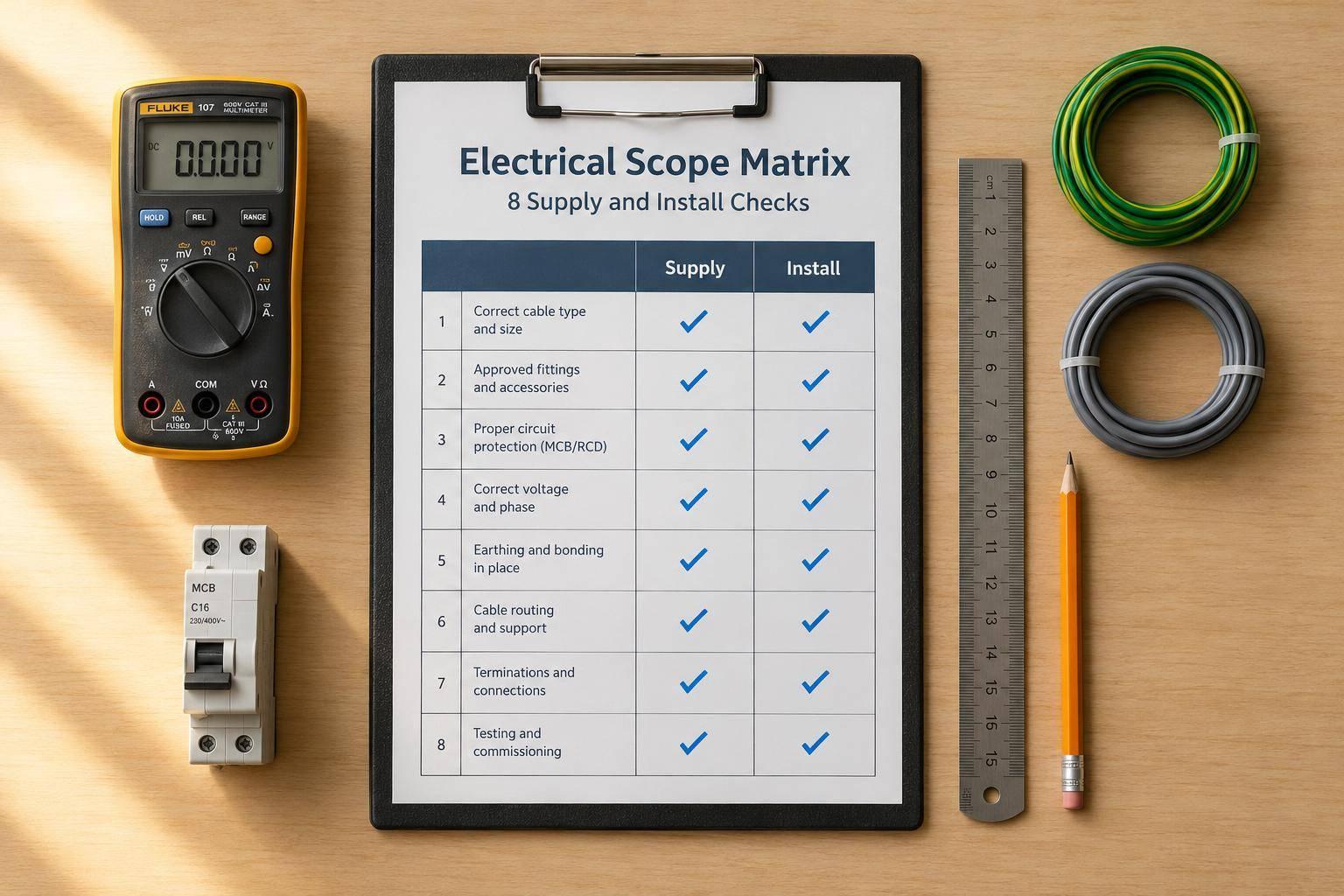
Electrical Scope Matrices: 8 Supply and Install Checks
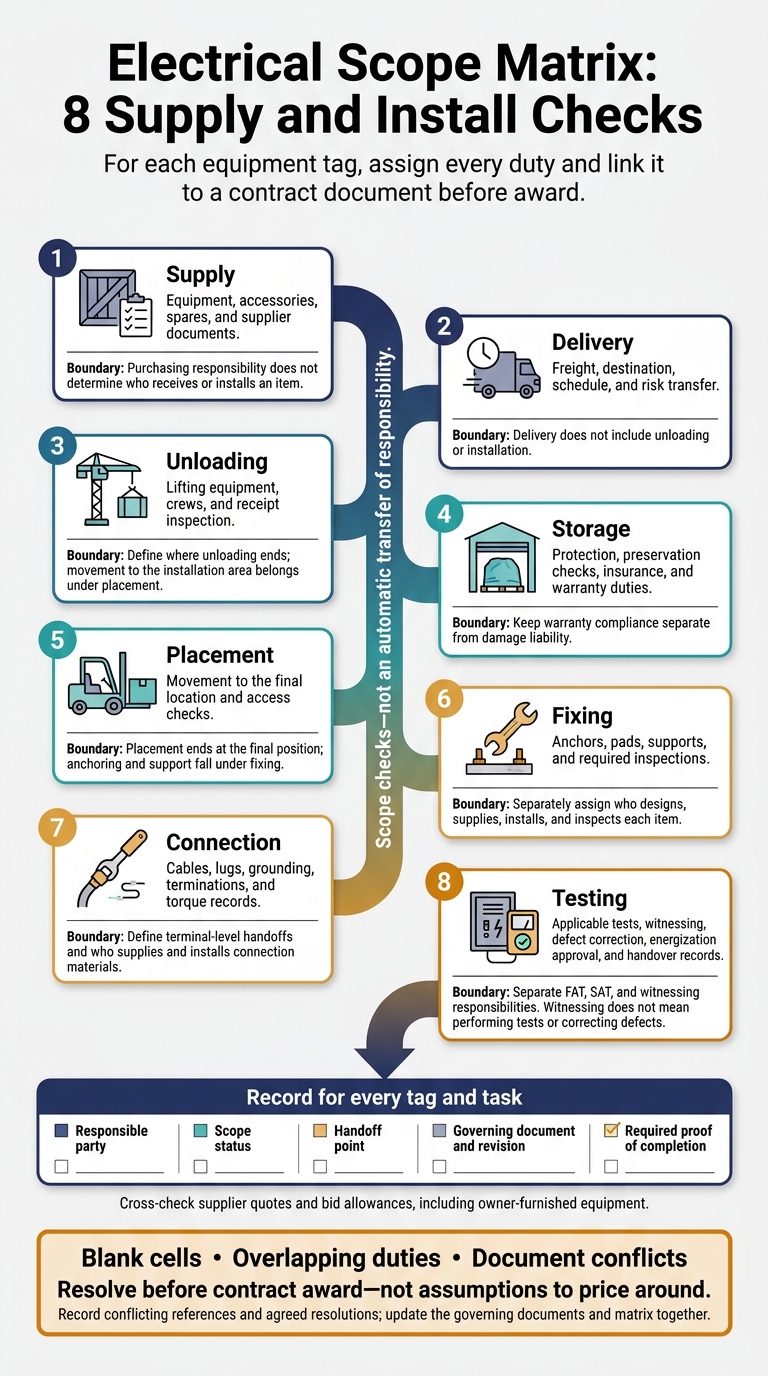
An electrical scope matrix should name who handles each of 8 tasks - and link every assignment to a contract document before award. Buying equipment does not automatically include unloading, installation, or testing.
Check each equipment tag against these duties:
- Supply: Equipment, accessories, spares, and supplier documents.
- Delivery: Freight, destination, schedule, and risk transfer.
- Unloading: Lifting equipment, crews, and receipt inspection.
- Storage: Protection, preservation checks, insurance, and warranty duties.
- Placement: Movement to the final location and access checks.
- Fixing: Anchors, pads, supports, and required inspections.
- Connection: Cables, lugs, grounding, terminations, and torque records.
- Testing: Applicable tests, witnessing, defect correction, energization approval, and handover records.
For every assignment, record the responsible party, scope status, handoff point, document revision, and required proof of completion. Treat blank cells, overlapping duties, and document conflicts as items to resolve - not assumptions to price around. Cross-check the matrix against supplier quotes and bid allowances, including duties for owner-furnished equipment.
Electrical Scope Matrix: 8 Supply and Install Checks
Checks 1–3: Supply, Delivery, and Unloading
1. Supply: Confirm Equipment and Accessories
For each tag, confirm who buys the equipment and required accessories. Review the specification, supplier quote, and purchase-order exclusions. Explicitly assign responsibility for drawings, spares, manuals, factory test certificates, warranty, and installation supervision.
Identify free-issued items and split-scope items separately. Purchasing responsibility does not determine who receives or installs an item. Use the same tag-and-party format for every later handoff.
2. Delivery: Assign Freight and Site Handoff
For each tag, record who pays freight, the delivery point, the delivery date, and the receiving contact. Be precise about the handoff location: the site gate, laydown yard, and final foundation are different destinations.
Delivery does not include unloading or installation. Assign those duties separately, and confirm the title and risk-of-loss terms.
3. Unloading: Assign Lifting and Receiving
Name who supplies the crane or forklift, rigging, and unloading crew, and who handles unpacking. Define exactly where unloading ends. Movement from the receiving area to the installation area belongs under placement. If the unloading scope is unclear, request clarification and state a priced allowance or an explicit exclusion.
Assign responsibility for the receiving inspection, shortage and damage reporting, and the receiving log. Receipt does not waive hidden defects, so confirm the notice window in the contract or shipping terms.
sbb-itb-f008923
Checks 4–6: Storage, Placement, and Fixing
4. Storage: Assign Preservation and Warranty Duties
After unloading, storage marks a scope boundary: who handles preservation, inspections, and risk while equipment waits for installation?
Assign responsibility for storage space, environmental protection, preservation inspections, temporary power, humidity control, desiccants, heater power, and rotating-equipment preservation. State who performs inspections and maintains the preservation log.
Keep warranty compliance separate from damage liability. Put warranty conditions in the Scope of Supply or SDRL. Assign storage, insurance, damage liability, and risk transfer in the Scope of Works and contract conditions. For free-issued equipment, name who receives, stores, moves, and installs it.
With storage duties assigned, check who moves the equipment to its exact installation point.
5. Placement: Assign Movement to the Final Location
Placement covers controlled movement from storage to the final location. It belongs in the Scope of Works or installation phase. Assign transport, lifting equipment, rigging, and labor for the move.
Before movement, assign responsibility for checking route dimensions, floor loads, pad and trench readiness, clearances, ventilation, and access against the approved layout and GA drawings. Log civil, structural, and mechanical readiness separately. Placement ends when the equipment reaches its position; anchoring and support fall under fixing.
The matrix then moves from equipment movement to permanent support work.
6. Fixing: Assign Anchors, Pads, and Supports
Fixing covers permanent anchoring and support work. Give foundations, housekeeping pads, anchor bolts, grout, support steel, cable tray supports, and seismic restraints separate matrix rows. For each item, name who designs, supplies, installs, and inspects it. Link electrical, civil, and structural handoffs to the equipment tag, structural details, GA drawings, and project requirements.
Use the inspection and test plan (ITP) to define acceptance criteria and witness points. Keep inspection records for the required checks. Flag drawing gaps, such as missing seismic restraints, during tender review - before pricing is finalized.
Checks 7–8: Connection, Testing, and the Worked Matrix
7. Connection: Define Terminal-Level Handoffs
Connection needs its own handoff - not just a line item. For each terminal handoff, name who supplies and installs the cabling, terminations, and grounding. Define the handoff using single-line diagrams, wiring diagrams, and termination schedules. Require the connecting party to document torque verification in the inspection and test record (ITR).
Then assign factory and site testing as separate responsibilities.
8. Testing: Assign Tests, Witnessing, and Handover
Keep FAT, SAT, and owner/engineer witnessing separate. For each tag, assign only the tests that apply to the asset: insulation resistance, continuity, grounding/bonding, phase, functional, protective-device, and manufacturer-required tests. Set acceptance criteria using project standards, manufacturer instructions, and authority having jurisdiction (AHJ) requirements - not a blanket test list.
Witnessing a test does not make that party responsible for performing it or correcting defects. Name who coordinates commissioning, corrects defects, authorizes energization, and submits as-builts, O&M manuals, and certificates. Settle defect responsibility for owner-furnished equipment before award. Track supplier documents through the Supplier Data Requirements List (SDRL) and field results through ITRs.
Worked Matrix: Match Tasks to Tags and Documents
Use this as a hypothetical worksheet, not a project record. Every document identifier, revision, boundary, and assignment is illustrative. “Included” means assigned within that party’s package; “Pending” requires agreement. Each row names one accountable party, with separate rows for performing and witnessing tests.
Use the matrix to assign each tag, task, document, and evidence item once.
Tag Task Responsible party Scope status Interface boundary Governing document and revision - hypothetical Required evidence Clarification status SWBD-01 1. Supply switchboard Manufacturer Included Complete factory assembly Spec 262413 Rev B Approved shop drawings; packing list Closed SWBD-01 2. Delivery Manufacturer Included Site gate, before unloading PO-101 Rev 1 Bill of lading Closed SWBD-01 3. Unloading Electrical contractor Pending Truck to receiving area Logistics Plan Rev 2 Receipt inspection Open - confirm lifting scope SWBD-01 4. Storage Electrical contractor Included Receiving area to release for placement Scope of Works Rev C Preservation log Closed SWBD-01 5. Placement Electrical contractor Included Storage to final position GA E-201 Rev 3 Placement inspection Closed SWBD-01 6. Fixing Electrical contractor Included Final position to secure installation Detail S-301 Rev 2 Fixing inspection record Closed SWBD-01 7. Supply termination materials Electrical contractor Pending Cable-to-equipment joints RFQ-101 Rev 2 Termination schedule Open - supplier exclusion unresolved SWBD-01 7. Make field connections Electrical contractor Included Incoming, outgoing, control, and ground terminals Wiring E-601 Rev 4 Termination and torque records Closed SWBD-01 8. FAT Manufacturer Included Factory assembly FAT Procedure Rev B FAT report Closed SWBD-01 8. SAT Electrical contractor Included Installed assembly and field connections ITP-SWBD Rev 2 Site test records Open - procedure approval SWBD-01 8. SAT witnessing Owner/Engineer Excluded ITP witness points ITP-SWBD Rev 2 Witness sign-off Closed SWBD-01 8. Authorize energization Owner Pending Release following accepted checks Energization Plan Rev A Written authorization Open - confirm authority TR-01 Supply owner-furnished transformer Owner Free issue Site delivery handoff PO-TR Rev 1 Delivery record Closed TR-01 Make field connections Electrical contractor Included Transformer bushings and ground pads Drawing E-101 Rev 3 Termination and grounding records Closed GEN-01 Coordinate site commissioning Electrical contractor Partial - confirm interface split Generator control interfaces Commissioning Plan Rev C Commissioning log Open - confirm interface duties GEN-01 Provide startup attendance Supplier Pending Generator package controls Vendor Scope Rev B Startup report Open - confirm attendance UPS-01 Connect input, output, and controls Electrical contractor Pending vendor-designated terminals Wiring W-02 Rev 2 Termination schedule; torque record Open - confirm lug supply MCC-01 Supply MCC Manufacturer Included Factory assembly SDRL-MCC Rev 1 Approved drawings; certificates Closed CBL-01 Perform continuity and insulation tests Electrical contractor Included Isolated cable ends Spec 260519 Rev B Cable test report Closed
Treat every open item or blank cell as a tender clarification. If documents conflict, enter both references in the conflict register rather than choosing one without resolution. Update the governing record and matrix together; the worksheet alone does not settle scope conflicts.
Conclusion: Close Scope Gaps Before Contract Award
After completing the worked matrix, cross-check all eight checks for each tag against supplier quotes, bid inclusions, and the pricing schedule or BOQ. Resolve gaps before contract award.
Matrix Assignment Quote or Pricing Allowance Discrepancy / Scope Gap Reviewer Required Action SWBD-01: Supply Included in supplier quote Missing factory test reports Lead estimator Issue RFI for test documentation SWBD-01: Delivery Excluded from supplier quote; assumed by owner Scope says “Delivered to Plinth” Logistics manager Update quote to include site transport SWBD-01: Unloading Not in BOQ or supplier quote No party assigned to lifting Project manager Add provisional sum for mobile crane SWBD-01: Storage Contractor’s site preliminaries Supplier requires climate control Commercial manager Qualify bid with storage container cost SWBD-01: Placement Included in electrical subcontract Drawing shows restricted access Site engineer Request revised rate for manual handling SWBD-01: Fixing Included in civil package Electrical specification requires seismic ties Structural lead Reassign seismic fixing to electrical SWBD-01: Connection Included in electrical subcontract Terminal lugs not supplied with board Electrical lead Supplier to provide lugs per specification SWBD-01: Testing Supplier attends; contractor leads No allowance for third-party witness Commissioning manager Add allowance for independent tester
Elora Grid helps extract tender requirements, prepare supplier inquiries, compare quotes, and spot scope gaps.
Record document conflicts and agreed resolutions in the conflict and variation register. Keep final matrix revisions and compliance decisions with project engineering and commercial reviewers. Before bid close, update the scope matrix, scope of work, drawings, specifications, and returnable schedules.
FAQs
How do I resolve conflicting scope documents?
Don’t favor one source without documenting why. Record each contradiction in a conflict and variation register. Cite the tender document, section, drawing revision, and quote line. Track requirements in a compliance matrix with stable IDs.
Follow the contract’s order-of-precedence clauses and submit an RFI during bidding to request written clarification. If the issue remains unresolved by the deadline, include a priced assumption or formal qualification in your bid to protect your margin and scope.
How should I price unresolved scope gaps?
Don’t invent costs. Keep unresolved scope gaps out of your base bid. List them separately as clearly labeled estimator allowances, with defined quantities, expected rates, and an uncertainty range.
Log each gap in a conflict and change register, and link it to the relevant bid documents, specifications, or drawings. Before submission, state your assumptions in the bid schedules or a written qualification. This helps protect your margin and supports scope and budget adjustments once you receive formal clarification.
When should I update the scope matrix after award?
Close all open scope matrix items before award. After signing, formally add accepted changes to scope, price, and conditions to the purchase order or subcontract. Recording them in review notes or bid comparison records alone isn’t enough.
If any scope items remain unresolved at award, document them as risks or assumptions. Track each item through formal resolution during project execution.