Missing Scope in Electrical Quotes: How AI Can Help
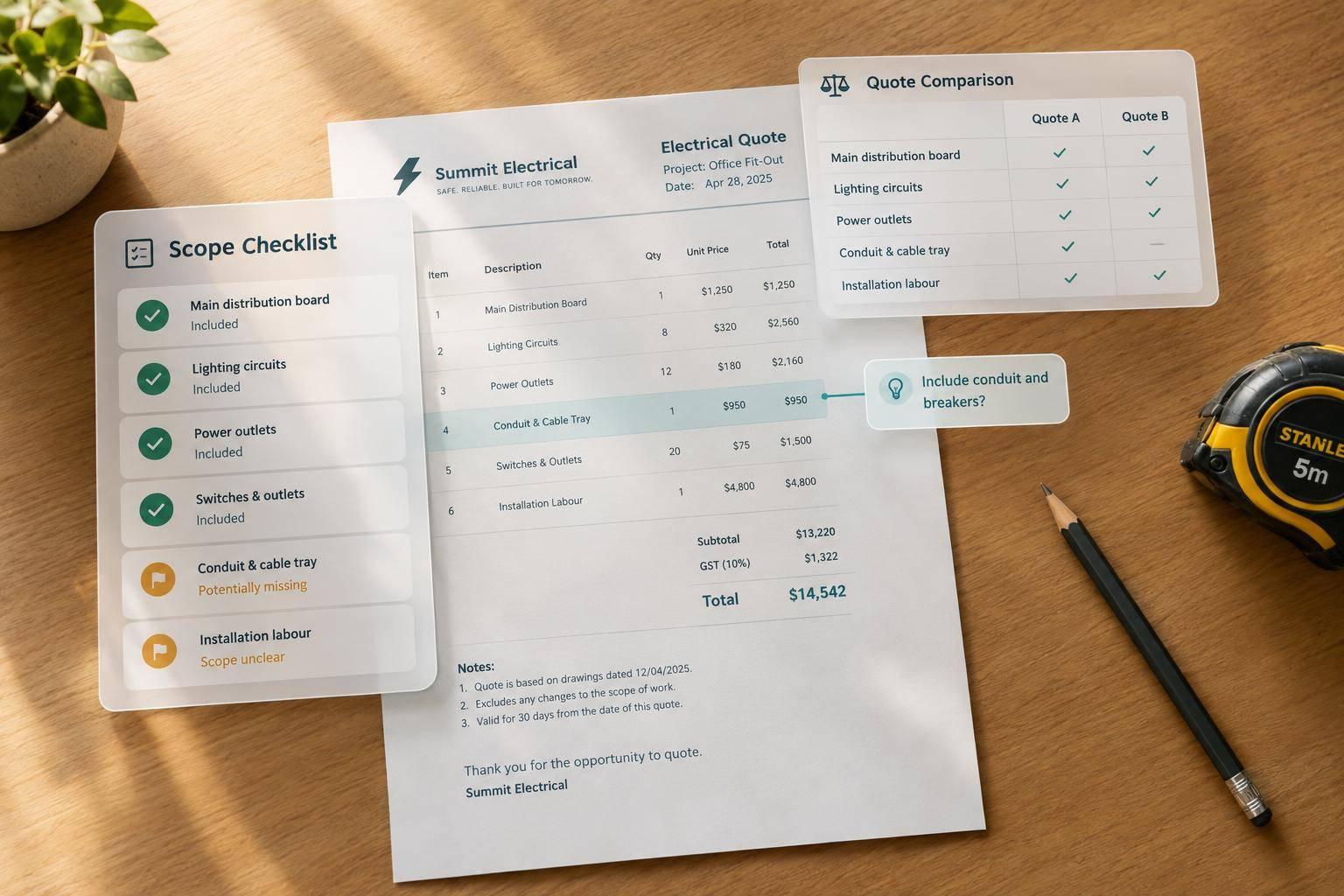
AI can flag possible gaps in electrical quotes - but it cannot confirm that all required work is covered. A quote for 500 feet of cable, for example, does not establish whether pulling, terminations, or testing are included.
A source-linked review follows three steps:
- Build a scope checklist from the governing tender documents, drawings, and addenda.
- Compare each quote against that checklist, keeping supply, installation, accessories, interfaces, testing, and closeout separate.
- Draft specific supplier questions to resolve exclusions, unclear wording, and work assigned to others.
Engineers and estimators must verify each finding, record written responses, and keep allowances separate from quoted prices. Accepted changes belong in the purchase order or subcontract - not just the review notes.
AI Electrical Quote Review: From Scope Check to Award
Step 1: Build a Source-Referenced Scope Checklist
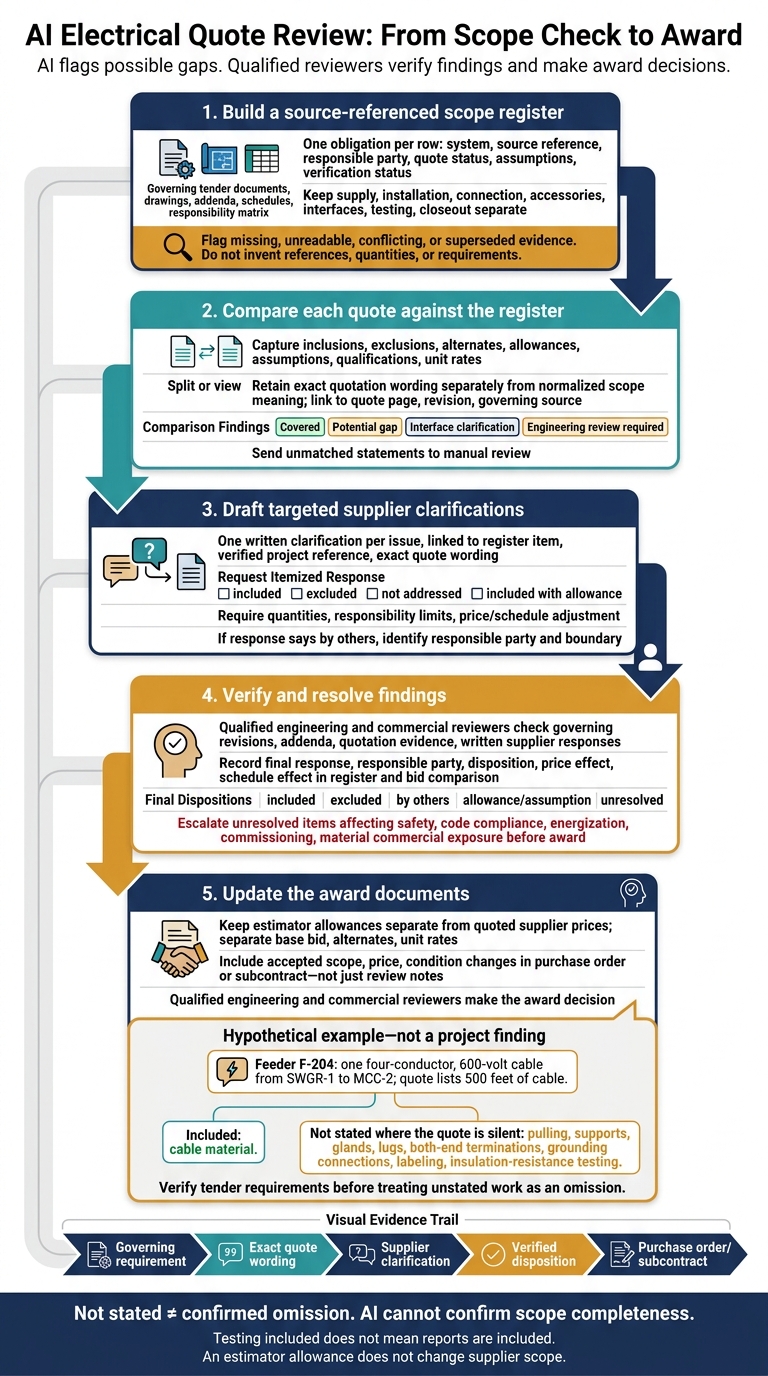
Ask AI to extract one obligation per register row, rather than summarize entire specification sections. Each row should record the system, source reference, responsible party, quote status, assumptions, and verification status. Flag evidence that is missing, unreadable, conflicting, or superseded. Do not let AI invent references, quantities, or requirements.
Group Requirements by System and Responsibility
Group rows by equipment, feeders and wiring, grounding and bonding, lighting, controls, communications, testing and commissioning, closeout documentation, and civil or structural interfaces. Use the same status tags throughout.
Keep supply, installation, connection, and testing obligations separate. Leave responsibility unconfirmed unless the documents assign it. Once it is settled, record the reviewer’s name and resolution date.
Check Terminations, Grounding, and Accessories
Break feeder scope into individual obligations: cable pulling, route preparation, glands, lugs, reducers, termination kits, labeling, dressing, cleats, supports, tray or conduit fittings, seals, firestopping, and connections at both ends.
For grounding and bonding, trace equipment-grounding conductors, jumpers, clamps, and grounding-electrode connections. A general grounding line is not enough. Check grounding and bonding separately, and confirm that accessories suit the specified cable, enclosure, and location.
Use separate rows for material supply, installation, and testing.
Hypothetical feeder F-204: One four-conductor, 600-volt cable runs from SWGR-1 to MCC-2. The quote lists F-204 cable, 500 feet. Mark cable material included. Mark pulling, supports, glands, lugs, both-end terminations, grounding connections, labeling, and insulation-resistance testing as not stated wherever the quote is silent. Verify which items the tender requires before treating them as omissions. Cable supply alone does not establish installation or termination scope.
Check Interfaces, Testing, and Closeout
Trace each interface from source to load, including power connections, control wiring, interlocks, instrument cabling, communications links, and required kits. Check trenching, bedding, backfill, sleeves, pads, penetrations, firestopping, conduit stub-ups, and temporary power, too.
Record specified tests, protection settings and studies, commissioning, startup support, reports, arc-flash labels, as-builts, training, and spares as separate obligations. Testing included does not mean reports are included. Record required witnesses, acceptance criteria, and deliverables. Customary practice is not evidence that an item is included in the quote.
Use this checklist to build the quote comparison table in Step 2.
sbb-itb-f008923
Step 2: Compare Quotes With the Scope Register
Extract each quote’s inclusions, exclusions, alternates, allowances, assumptions, qualifications, and unit rates. Use the Step 1 register as the baseline for every comparison.
Retain the quote revision, date, page, validity period, currency in U.S. dollars where applicable, tax treatment, and delivery terms. Store the exact quote wording in one field and its normalized scope meaning in another. Don’t expand what the supplier has committed to provide.
Match each extracted statement to one register row and its source revision before assigning a finding. Send statements without a match to manual review.
Keep the existing quote-status tags and add a comparison finding:
- Covered: Explicit scope that matches the requirement.
- Potential gap: Required work that is excluded or unstated.
- Interface clarification: Unclear or overlapping ownership.
- Engineering review required: Technical ambiguity or conflicting requirements.
Build a Traceable Quote Comparison Table
Keep one requirement per row in the working register, with linked evidence for each bidder. Record the page and revision alongside every quoted passage.
The rows below are hypothetical review examples, not project findings or actual supplier quotations.
Scope item Tender or drawing reference Supplier or contractor Exact quoted wording Quantity or equipment tag Potential gap Responsible party Clarification required Cost or schedule exposure Engineer verification status Cable terminations Cable schedule C-201; MCC-01 detail Contractor A “Cable pulling included; terminations excluded.” C-101; 2 ends Potential gap - explicit exclusion; lugs, glands, labeling, torqueing, and termination testing may be missing Contractor A or equipment installer Confirm supply, installation, and testing of both-end terminations Additional material and labor; possible energization delay Pending clarification Grounding connections Grounding plan E-305; transformer T-01 Supplier B “equipment grounding included.” T-01; 1 transformer Interface clarification; conductors, lugs, jumpers, and test report not identified Unconfirmed Separate factory provisions, field bonding, and grid connections; confirm ownership Possible duplicate pricing or uncovered field work Engineering review required Tray accessories Layout E-410 Contractor C “Cable tray: 600 linear feet.” CT-01 through CT-04 Potential gap; bends, covers, drop-outs, splice plates, supports, expansion fittings, and bonding accessories not stated Contractor C Confirm whether accessories and supports are included in the stated footage Added material and labor; accessory delivery may delay installation Pending clarification Functional testing Specification 26 08 00; commissioning plan All quotes “megger test” MCC-01; P-01/P-02 Potential gap; continuity, polarity, protective-device testing, functional checks, witness testing, and reports not stated; insulation-resistance scope unclear Testing agency or electrical contractor Confirm test scope, standards, witness requirements, and deliverables Testing availability may delay energization and turnover Engineering review required
Keep quoted prices separate from estimator allowances. Also separate the base bid from alternates and unit rates. For unresolved rows, describe likely exposure - such as extra terminations, accessories, or testing - without inventing dollar amounts or schedule delays.
AI flags possible omissions for engineering verification; it does not confirm scope completeness. Use unresolved rows to draft targeted supplier clarifications in Step 3.
Step 3: Draft Supplier Clarifications With AI
Use AI to draft one written clarification per issue. Link each clarification to its register item, verified project reference, and exact quotation wording. Ask for an itemized response: included, excluded, not addressed, or included with allowance. Each response should state quantities, responsibility limits, and any price or schedule adjustment. Don’t ask suppliers to confirm complete scope.
Ask Specific Scope and Responsibility Questions
For feeder F-204, ask whether the price includes pulling, glands, lugs, labeling, both-end terminations, testing, and final connections. Require separate confirmation for the MCC-2 and P-204 ends. Before sending the request, attach the actual cable schedule row, termination detail, specification paragraph, and quotation line item. Don’t use assumed drawing numbers.
Keep grounding and startup requests separate. For grounding, ask for conductor sizes and quantities, bonding jumpers, clamps, connection points, continuity tests, and reports. For startup, ask which personnel, visits, labor hours, calibrated instruments, retesting, and final reports are included. Link each request to its equipment tag and governing requirement, and have the engineer verify the testing interpretation.
Address installation boundaries separately. Who supplies and installs sleeves, creates penetrations, and provides firestopping? For tray, ask whether the quoted linear footage includes fittings, supports, covers, and transitions. Request fitting quantities, too. Cite the applicable architectural details, tray drawings, and responsibility matrix. If the response says by others, require the supplier to name the responsible party and define the boundary rather than leave the handoff unresolved.
Use a Copy-and-Paste Review Prompt
Review the attached tender specifications, drawings, addenda, equipment and cable schedules, responsibility matrix, and electrical quotation. Extract every electrical obligation you can identify and cite its exact document, revision, page, drawing, detail, equipment tag, or schedule row. Flag inaccessible or unreadable sources and uncertain interpretations. Organize findings by system and classify each as included, excluded, unclear, not addressed, duplicated, or conflicting. Compare supply, installation, accessories, interfaces, testing, commissioning, documentation, and closeout. Pay particular attention to terminations, glands, lugs, grounding/earthing, bonding, supports, tray fittings, field connections, controls wiring, firestopping, trenching, temporary power, protection studies, labeling, and as-builts. Produce a table with requirement, source reference, quoted wording, status, potential scope gap, responsible party, clarification question, and engineering verification required. Do not infer inclusion from silence or invent references. Do not confirm scope completeness, contractual responsibility, technical compliance, or final cost. Flag uncertainties for a qualified engineer or estimator.
Conclusion: Verify Scope Findings Before Award
Once suppliers return their clarifications, close each item before award. Treat AI findings as potential risks, not confirmed omissions. Qualified engineering and commercial reviewers must trace every flag to the governing documents and quote line items already in the register. Check the governing revisions and applicable addenda, then record each item as included, excluded, by others, allowance/assumption, or unresolved.
Resolve Open Items and Update the Bid Comparison
Close open items using the same status tags as the comparison table. Link each written supplier clarification to its quote revision and source reference. Record the final response, responsible party, disposition, price effect, and schedule effect in both the register and bid comparison table. Before award, escalate unresolved items that affect safety, code compliance, energization, commissioning, or material commercial exposure.
Keep estimator allowances separate from supplier pricing. An allowance does not change supplier scope unless written confirmation changes the offer. Include accepted changes to scope, price, and conditions in the purchase order or subcontract.
After updating the comparison, route the record into the bid decision. AI supports scope review; qualified engineering and commercial reviewers make the award decision.
FAQs
How do I prioritize AI-flagged scope gaps?
Prioritize gaps by material impact and technical need. Check each AI-flagged gap against specifications, single-line diagrams, and equipment schedules. Confirm that the item is missing, rather than covered elsewhere. Log verified gaps and their source references in your conflict and variation register.
For each confirmed gap, request formal clarification from the supplier, include a priced allowance with an explicit assumption, or state a formal qualification in your bid submission.
What if a quote conflicts with the tender?
Treat the discrepancy as an item to resolve formally, not an automatic exclusion. Add it to a conflict and variation register, citing the tender document, section, or drawing revision and the relevant quote line.
If there’s time before the bid deadline, submit an RFI requesting written clarification from the client. If no answer arrives or time is short, include a formal qualification or priced assumption in your bid to protect your scope and margin.
How can I check whether AI missed a requirement?
Check AI’s output against the original tender documents, and open the sources it cites to confirm accuracy. Before treating an omitted detail as missing scope, review the related equipment schedules, specifications, and drawings.
Record unresolved gaps in your conflict and variation register. Address them through formal RFIs, bid clarifications, or priced assumptions. Don’t ignore gaps or let AI infer design intent.