SE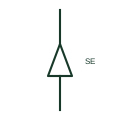
Single-core cable sealing end
The termination at the end of a single-core cable where it is sealed and connected to an overhead line or equipment.
IEC
IEEE-oriented pothead symbol marking a sealed cable termination where an insulated cable meets an overhead line or bus.
In plain English
Pothead is the traditional North American term for a sealed cable termination, especially at riser poles and outdoor substations. IEEE-style single-line diagrams show it where a cable rises to connect to an overhead line or open bus, often with a lightning arrester beside it.
This illustration is an independent explanation of the convention and is not the IEEE graphic. Modern terminations may be porcelain, polymer or slip-on types, all of which may be called potheads on older drawings. Rating and creepage distance belong in the equipment data.
Look for an arrester at riser pole potheads. Treat older pothead labels as any sealed termination type. A pothead is a fixed sealed termination; a separable connector can be unplugged.
IEEE-oriented pothead symbol marking a sealed cable termination where an insulated cable meets an overhead line or bus. A pothead is a fixed sealed termination; a separable connector can be unplugged.
Read the source: IEEE/ANSI 315-1975: graphic symbols for electrical and electronics diagrams · Elastimold underground cable accessories
Independent illustration in IEEE drafting context; no equivalence of every detailed standard graphic is asserted.
Shown as an independently authored educational illustration. Use the cited publication and drawing legend to verify the required drafting form.
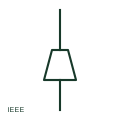
Pothead is the traditional North American term for a sealed cable termination, especially at riser poles and outdoor substations. IEEE-style single-line diagrams show it where a cable rises to connect to an overhead line or open bus, often with a lightning arrester beside it.
This illustration is an independent explanation of the convention and is not the IEEE graphic. Modern terminations may be porcelain, polymer or slip-on types, all of which may be called potheads on older drawings. Rating and creepage distance belong in the equipment data.
A pothead is a fixed sealed termination; a separable connector can be unplugged.
These public references support the explanation and provide further detail. Their graphics and downloadable files remain with their publishers.
Graphic-symbol standards context and official status; not a source of reproduced artwork.
Manufacturer context for cable terminations.
This illustration was authored independently by Elora Grid to explain the concept. It is not reproduced from a customer drawing, an official standard graphic or a manufacturer CAD file. Its correspondence to an exact IEC or IEEE symbol identifier has not been certified.
SVG and DXF downloads contain this original artwork. DXF uses unscaled drawing units; a GA envelope supplies no product dimensions, clearances or fabrication information. Original artwork is available under CC BY 4.0. Third-party references retain their own terms.
The termination at the end of a single-core cable where it is sealed and connected to an overhead line or equipment.
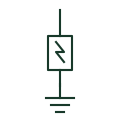
IEEE-oriented surge arrester symbol connected between a line and ground to limit transient overvoltage.
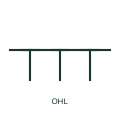
A line or route mark identifying conductors carried overhead on poles or towers rather than buried or enclosed.
Elora Grid helps electrical teams work with drawings, specifications and equipment information. Explore the drafting workflow or join the early-access waitlist.