NER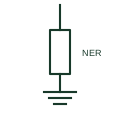
Neutral earthing resistor
A resistor between a transformer or generator neutral and earth that limits earth-fault current to a set value.
SLD / Schematic
An adjustable reactor between neutral and earth tuned to cancel the network capacitive earth-fault current.
In plain English
An arc suppression coil is a reactor connected between the system neutral and earth, tuned so that its inductive current balances the capacitive current that flows during a single phase-to-earth fault. The residual fault current becomes very small, so transient arcing faults often self-extinguish and the network can keep running with a sustained earth fault.
Drawings show an inductor with an adjustment arrow between a transformer or earthing transformer neutral and earth, often with a parallel resistor switched in briefly to help fault location. Automatic tuning controllers and neutral voltage measurement are drawn alongside.
Resonant earthing needs dedicated earth-fault detection, such as transient or admittance-based protection, because fault current is too small for simple overcurrent relays. The symbol does not show the tuning range or the detection method.
An adjustable reactor between neutral and earth tuned to cancel the network capacitive earth-fault current. An arc suppression coil cancels capacitive fault current; a neutral earthing resistor limits fault current but does not cancel it.
Read the source: Residual current and neutral-earthing protection context · AutoCAD Electrical: Reactors and inductors
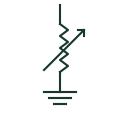
An arc suppression coil is a reactor connected between the system neutral and earth, tuned so that its inductive current balances the capacitive current that flows during a single phase-to-earth fault. The residual fault current becomes very small, so transient arcing faults often self-extinguish and the network can keep running with a sustained earth fault.
Drawings show an inductor with an adjustment arrow between a transformer or earthing transformer neutral and earth, often with a parallel resistor switched in briefly to help fault location. Automatic tuning controllers and neutral voltage measurement are drawn alongside.
Resonant earthing needs dedicated earth-fault detection, such as transient or admittance-based protection, because fault current is too small for simple overcurrent relays. The symbol does not show the tuning range or the detection method.
An arc suppression coil cancels capacitive fault current; a neutral earthing resistor limits fault current but does not cancel it.
These public references support the explanation and provide further detail. Their graphics and downloadable files remain with their publishers.
Public earth-fault and neutral earthing protection context.
Public reactor symbol family context.
This illustration was authored independently by Elora Grid to explain the concept. It is not reproduced from a customer drawing, an official standard graphic or a manufacturer CAD file. Its correspondence to an exact IEC or IEEE symbol identifier has not been certified.
SVG and DXF downloads contain this original artwork. DXF uses unscaled drawing units; a GA envelope supplies no product dimensions, clearances or fabrication information. Original artwork is available under CC BY 4.0. Third-party references retain their own terms.
A resistor between a transformer or generator neutral and earth that limits earth-fault current to a set value.
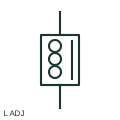
An adjustable-core inductor varies its documented inductive characteristic through a magnetic adjustment.

Supervises transient or intermittent earth-fault behaviour in the documented feeder application.

A zigzag winding interconnects portions of phase windings in a specified arrangement.
Elora Grid helps electrical teams work with drawings, specifications and equipment information. Explore the drafting workflow or join the early-access waitlist.