BAT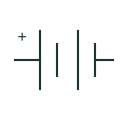
Battery
An electrochemical electrical source or storage element represented in a circuit.
SLD / Schematic
One electrochemical cell drawn as a single long plate and short plate pair, marking cell-level voltage and polarity.
In plain English
The single cell symbol is one long line for the positive plate and one shorter, often thicker, line for the negative plate. It represents one electrochemical cell, for example a 2 V lead-acid cell or a nominal 3.2 V lithium iron phosphate cell, and is the building block from which battery symbols are composed.
It appears on schematics where cell-level detail matters, such as cell monitoring connections, a backup cell on a controller board or a pilot cell for temperature and voltage measurement in a stationary battery. On power single-line diagrams the multi-cell battery symbol is normally used instead.
The symbol shows polarity but not chemistry, capacity or nominal voltage, all of which must be labelled. Drawing one cell does not mean the battery has one cell; check whether the drawing uses a single cell glyph as shorthand for a whole battery.
One electrochemical cell drawn as a single long plate and short plate pair, marking cell-level voltage and polarity. A single cell is one plate pair; the battery symbol repeats plate pairs or adds a dashed line between them to show several cells.
Read the source: IEC graphical symbols for diagrams · IEEE/ANSI 315-1975: graphic symbols for electrical and electronics diagrams
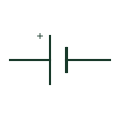
The single cell symbol is one long line for the positive plate and one shorter, often thicker, line for the negative plate. It represents one electrochemical cell, for example a 2 V lead-acid cell or a nominal 3.2 V lithium iron phosphate cell, and is the building block from which battery symbols are composed.
It appears on schematics where cell-level detail matters, such as cell monitoring connections, a backup cell on a controller board or a pilot cell for temperature and voltage measurement in a stationary battery. On power single-line diagrams the multi-cell battery symbol is normally used instead.
The symbol shows polarity but not chemistry, capacity or nominal voltage, all of which must be labelled. Drawing one cell does not mean the battery has one cell; check whether the drawing uses a single cell glyph as shorthand for a whole battery.
A single cell is one plate pair; the battery symbol repeats plate pairs or adds a dashed line between them to show several cells.
These public references support the explanation and provide further detail. Their graphics and downloadable files remain with their publishers.
IEC graphical symbol context for cells and batteries.
IEEE/ANSI graphic-symbol context for cells.
This illustration was authored independently by Elora Grid to explain the concept. It is not reproduced from a customer drawing, an official standard graphic or a manufacturer CAD file. Its correspondence to an exact IEC or IEEE symbol identifier has not been certified.
SVG and DXF downloads contain this original artwork. DXF uses unscaled drawing units; a GA envelope supplies no product dimensions, clearances or fabrication information. Original artwork is available under CC BY 4.0. Third-party references retain their own terms.
An electrochemical electrical source or storage element represented in a circuit.
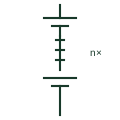
A series connection of cells or modules reaching the system DC voltage, often with its own fuse or breaker and monitoring.
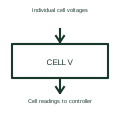
A cell voltage monitor measures individual cells within a series-connected battery.
Elora Grid helps electrical teams work with drawings, specifications and equipment information. Explore the drafting workflow or join the early-access waitlist.