DC-DC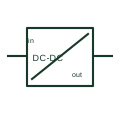
DC-to-DC converter
A DC/DC converter changes a documented DC input into another DC output.
SLD / Schematic
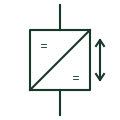
A DC/DC stage that can pass power in either direction, linking a battery or supercapacitor to a DC bus.
In plain English
A bidirectional DC/DC converter moves power in either direction between two DC voltage levels. In microgrids and DC-coupled solar plants it connects a battery or supercapacitor to a common DC bus, charging the store from surplus and discharging it when the bus voltage falls.
The drawing is the DC/DC converter box with DC marks on both sides and a bidirectional arrow, or a double-headed arrow along the box. Detailed schematics may show a half-bridge buck-boost or dual-active-bridge circuit arrangement inside.
The symbol does not state whether the two sides are galvanically isolated, the current limits in each direction, or the control mode, which may regulate bus voltage or battery current. These must come from the converter data.
A DC/DC stage that can pass power in either direction, linking a battery or supercapacitor to a DC bus. A bidirectional converter transfers power both ways; a standard DC/DC converter passes power from input to output only.
Read the source: TIDA-010054: bidirectional dual-active-bridge reference design · Autodesk IEC-60617 preview: Energy-flow qualifiers
A bidirectional DC/DC converter moves power in either direction between two DC voltage levels. In microgrids and DC-coupled solar plants it connects a battery or supercapacitor to a common DC bus, charging the store from surplus and discharging it when the bus voltage falls.
The drawing is the DC/DC converter box with DC marks on both sides and a bidirectional arrow, or a double-headed arrow along the box. Detailed schematics may show a half-bridge buck-boost or dual-active-bridge topology inside.
The symbol does not state whether the two sides are galvanically isolated, the current limits in each direction, or the control mode, which may regulate bus voltage or battery current. These must come from the converter data.
A bidirectional converter transfers power both ways; a standard DC/DC converter passes power from input to output only.
These public references support the explanation and provide further detail. Their graphics and downloadable files remain with their publishers.
Public bidirectional DC/DC reference design context.
Public IEC-context energy-flow qualifier family.
This illustration was authored independently by Elora Grid to explain the concept. It is not reproduced from a customer drawing, an official standard graphic or a manufacturer CAD file. Its correspondence to an exact IEC or IEEE symbol identifier has not been certified.
SVG and DXF downloads contain this original artwork. DXF uses unscaled drawing units; a GA envelope supplies no product dimensions, clearances or fabrication information. Original artwork is available under CC BY 4.0. Third-party references retain their own terms.
A DC/DC converter changes a documented DC input into another DC output.
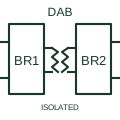
A conversion stage with controlled bridges on both sides of a coupled magnetic link.
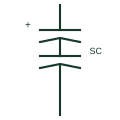
A series-parallel array of double-layer capacitor cells storing energy for very fast, short-duration power delivery.

A DC/DC converter with an internal high-frequency transformer that separates input and output galvanically.
Elora Grid helps electrical teams work with drawings, specifications and equipment information. Explore the drafting workflow or join the early-access waitlist.