GFM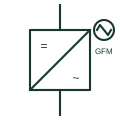
Grid-forming inverter
An inverter controlled as a voltage source that sets its own voltage and frequency, able to energise and hold up an island.
SLD
An inverter that tracks an existing network voltage with a phase-locked loop and injects controlled current into it.
In plain English
A grid-following inverter measures the network voltage, locks to it with a phase-locked loop and injects a controlled current. Most rooftop and utility-scale solar inverters work this way. They need a stable voltage from the grid, a synchronous machine or a grid-forming inverter to operate, and they disconnect when that reference is lost.
Drawings use the standard inverter symbol with a GFL note or a current-source annotation. Anti-islanding protection, often shown as a protection relay or a function list, is associated with this type so that it does not energise a dead network.
In weak networks with high converter penetration, grid-following control can become unstable, so system strength studies are needed. The symbol does not show the phase-locked loop settings or the reactive power mode.
An inverter that tracks an existing network voltage with a phase-locked loop and injects controlled current into it. A grid-following inverter needs an external voltage reference; a grid-forming inverter provides that reference.
Read the source: Photovoltaic technology and inverter functions · Solar electrical system architecture
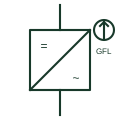
A grid-following inverter measures the network voltage, locks to it with a phase-locked loop and injects a controlled current. Most rooftop and utility-scale solar inverters work this way. They need a stable voltage from the grid, a synchronous machine or a grid-forming inverter to operate, and they disconnect when that reference is lost.
Drawings use the standard inverter symbol with a GFL note or a current-source annotation. Anti-islanding protection, often shown as a protection relay or a function list, is associated with this type so that it does not energise a dead network.
In weak networks with high converter penetration, grid-following control can become unstable, so system strength studies are needed. The symbol does not show the phase-locked loop settings or the reactive power mode.
A grid-following inverter needs an external voltage reference; a grid-forming inverter provides that reference.
These public references support the explanation and provide further detail. Their graphics and downloadable files remain with their publishers.
Public photovoltaic inverter function context.
Public solar electrical system architecture context.
This illustration was authored independently by Elora Grid to explain the concept. It is not reproduced from a customer drawing, an official standard graphic or a manufacturer CAD file. Its correspondence to an exact IEC or IEEE symbol identifier has not been certified.
SVG and DXF downloads contain this original artwork. DXF uses unscaled drawing units; a GA envelope supplies no product dimensions, clearances or fabrication information. Original artwork is available under CC BY 4.0. Third-party references retain their own terms.
An inverter controlled as a voltage source that sets its own voltage and frequency, able to energise and hold up an island.
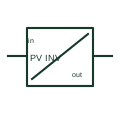
A photovoltaic inverter converts a documented PV DC input into an AC output and provides the selected PV control functions.
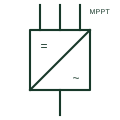
A solar inverter connecting a small number of PV strings directly, each group tracked by its own MPPT input.
Supervises a voltage-time ride-through criterion used in a generator or interconnection application.
Elora Grid helps electrical teams work with drawings, specifications and equipment information. Explore the drafting workflow or join the early-access waitlist.