DECADE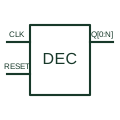
Decoded decade counter
Advances a decoded output sequence through the documented ten-state counter arrangement.
Schematic
IEC counter marked CTR DIV10, counting through ten states with BCD-weighted outputs.
In plain English
CTR DIVm identifies a counter whose cycle length is m. A decade counter is therefore CTR DIV10, with outputs weighted 1, 2, 4 and 8 for a BCD count from 0 to 9. The carry output is often marked CT=9 to show it is active at the last state.
Decade counters drive numeric displays through BCD-to-seven-segment decoders and form decimal dividers in timing circuits. A drafter cascading stages should show the CT=9 carry feeding the enable of the next decade.
This differs from a decoded one-of-ten counter, which provides ten separate outputs rather than a BCD code. Check the outputs before assuming either form.
IEC counter marked CTR DIV10, counting through ten states with BCD-weighted outputs. The decoded decade counter has ten one-hot outputs rather than BCD-weighted outputs.
Read the source: Overview of IEEE Standard 91-1984: explanation of logic symbols (SDYZ001A)
Qualifying-symbol and dependency conventions as explained in TI's public overview of IEEE Std 91-1984, which incorporates IEC 617-12 work. Independent educational drawing; not certified IEC geometry or an IEC database identifier.
Shown as an independently authored educational illustration. Use the cited publication and drawing legend to verify the required drafting form.
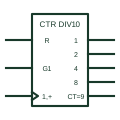
CTR DIVm identifies a counter whose cycle length is m. A decade counter is therefore CTR DIV10, with outputs weighted 1, 2, 4 and 8 for a BCD count from 0 to 9. The carry output is often marked CT=9 to show it is active at the last state.
Decade counters drive numeric displays through BCD-to-seven-segment decoders and form decimal dividers in timing circuits. A drafter cascading stages should show the CT=9 carry feeding the enable of the next decade.
This differs from a decoded one-of-ten counter, which provides ten separate outputs rather than a BCD code. Check the outputs before assuming either form.
The decoded decade counter has ten one-hot outputs rather than BCD-weighted outputs.
These public references support the explanation and provide further detail. Their graphics and downloadable files remain with their publishers.
Defines CTR DIVm and contents outputs such as CT=9.
This illustration was authored independently by Elora Grid to explain the concept. It is not reproduced from a customer drawing, an official standard graphic or a manufacturer CAD file. Its correspondence to an exact IEC or IEEE symbol identifier has not been certified.
SVG and DXF downloads contain this original artwork. DXF uses unscaled drawing units; a GA envelope supplies no product dimensions, clearances or fabrication information. Original artwork is available under CC BY 4.0. Third-party references retain their own terms.
Advances a decoded output sequence through the documented ten-state counter arrangement.
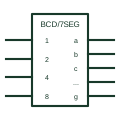
IEC coder marked BCD/7SEG converting a 4-bit BCD input into seven segment-drive outputs a to g.
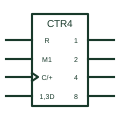
IEC counter marked CTRm, where m is the bit count and the cycle length is 2 to the power m.
Elora Grid helps electrical teams work with drawings, specifications and equipment information. Explore the drafting workflow or join the early-access waitlist.