JUNCTION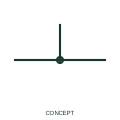
Conductor connection junction
A junction indication marks a documented electrical connection between conductor branches.
Schematic
A conductor meeting another at a right angle and stopping there, which IEC practice reads as a connection even without a dot.
In plain English
In IEC drawing practice a conductor that runs into another and ends there forms a T-connection, and the connection is understood whether or not a dot is drawn. Many drafting standards still recommend the dot for clarity, but undotted tees are common on legacy and vendor drawings.
The convention depends on the drawing family. On some ANSI-style drawings an undotted tee may be ambiguous, which is why a dot is preferred there. Readers should check the drawing legend. A T-connection only shows electrical continuity; it does not tell you where the physical joint is, which may be at a terminal some distance away.
Check the legend to see whether undotted tees are used as connections. Find the physical terminal or joint that realises the tee. An undotted tee is a connection; a plain four-way crossing without a dot is normally read as no connection.
A conductor meeting another at a right angle and stopping there, which IEC practice reads as a connection even without a dot. An undotted tee is a connection; a plain four-way crossing without a dot is normally read as no connection.
Read the source: Wire connection dots, crossing gaps and loops · IEC-60617 symbol preview directory
Independent IEC-context illustration of a drafting convention; not certified IEC geometry.
Shown as an independently authored educational illustration. Use the cited publication and drawing legend to verify the required drafting form.
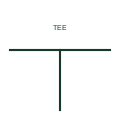
In IEC drawing practice a conductor that runs into another and ends there forms a T-connection, and the connection is understood whether or not a dot is drawn. Many drafting standards still recommend the dot for clarity, but undotted tees are common on legacy and vendor drawings.
The convention depends on the drawing family. On some ANSI-style drawings an undotted tee may be ambiguous, which is why a dot is preferred there. Readers should check the drawing legend. A T-connection only shows electrical continuity; it does not tell you where the physical joint is, which may be at a terminal some distance away.
An undotted tee is a connection; a plain four-way crossing without a dot is normally read as no connection.
These public references support the explanation and provide further detail. Their graphics and downloadable files remain with their publishers.
Public guidance on connection dots, crossing gaps and loops.
Public directory of IEC-oriented symbol families.
This illustration was authored independently by Elora Grid to explain the concept. It is not reproduced from a customer drawing, an official standard graphic or a manufacturer CAD file. Its correspondence to an exact IEC or IEEE symbol identifier has not been certified.
SVG and DXF downloads contain this original artwork. DXF uses unscaled drawing units; a GA envelope supplies no product dimensions, clearances or fabrication information. Original artwork is available under CC BY 4.0. Third-party references retain their own terms.
A junction indication marks a documented electrical connection between conductor branches.
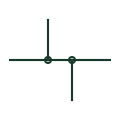
Four conductors joined using two offset T-junctions rather than one crossing dot, to avoid confusion with a crossing.
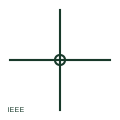
IEEE-oriented junction dot marking a connection between crossing or meeting conductors on an ANSI-style schematic.
Elora Grid helps electrical teams work with drawings, specifications and equipment information. Explore the drafting workflow or join the early-access waitlist.