kWh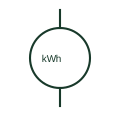
Active-energy meter
An active-energy meter accumulates active power over time.
SLD / Schematic
Energy meter that switches between registers by time or tariff signal so energy is billed at different rates.
In plain English
A multi-rate meter has two or more registers and switches between them according to an internal clock or an external tariff signal. Older installations use a ripple control receiver or time switch to change rate, which is why the schematic may show a control input to the meter.
The symbol marks the multiple registers but not the rate schedule. Tariff periods are set by the supply agreement and meter programming, and the drawing should reference the tariff source rather than assume it from the meter form.
Look for an external tariff switching input. Check that the register count matches the tariff. A multi-rate meter splits energy by time or tariff; a bidirectional meter splits energy by direction.
Energy meter that switches between registers by time or tariff signal so energy is billed at different rates. A multi-rate meter splits energy by time or tariff; a bidirectional meter splits energy by direction.
Read the source: Power and energy measurement quantities · IEC graphical symbols for diagrams
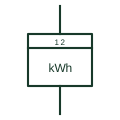
A multi-rate meter has two or more registers and switches between them according to an internal clock or an external tariff signal. Older installations use a ripple control receiver or time switch to change rate, which is why the schematic may show a control input to the meter.
The symbol marks the multiple registers but not the rate schedule. Tariff periods are set by the supply agreement and meter programming, and the drawing should reference the tariff source rather than assume it from the meter form.
A multi-rate meter splits energy by time or tariff; a bidirectional meter splits energy by direction.
These public references support the explanation and provide further detail. Their graphics and downloadable files remain with their publishers.
Public explanation of energy and power measurement quantities used by meters.
IEC context for graphical symbols used in diagrams; no IEC graphic is reproduced.
This illustration was authored independently by Elora Grid to explain the concept. It is not reproduced from a customer drawing, an official standard graphic or a manufacturer CAD file. Its correspondence to an exact IEC or IEEE symbol identifier has not been certified.
SVG and DXF downloads contain this original artwork. DXF uses unscaled drawing units; a GA envelope supplies no product dimensions, clearances or fabrication information. Original artwork is available under CC BY 4.0. Third-party references retain their own terms.
An active-energy meter accumulates active power over time.
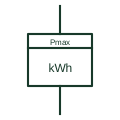
Energy meter that also records the highest average power over a fixed demand interval for demand charging.
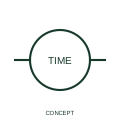
A clock indication identifies a time display or clock function in the circuit documentation.
Elora Grid helps electrical teams work with drawings, specifications and equipment information. Explore the drafting workflow or join the early-access waitlist.