INV/CHG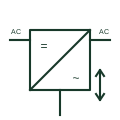
Bidirectional inverter-charger
A battery converter that charges from an AC source and inverts back to AC, with an internal transfer relay for the load.
SLD / Schematic
An inverter with two 180-degree displaced outputs and a neutral, supplying 120/240 V split-phase installations.
In plain English
A split-phase inverter produces two AC outputs 180 degrees apart with a shared neutral, giving 120 V from each line to neutral and 240 V between lines. This matches North American residential and small commercial supplies, so the inverter can feed a standard load centre in off-grid or backup systems.
Drawings show the inverter block with three AC output conductors, L1, L2 and N, often with an internal or external autotransformer that balances unequal loads on the two halves. Neutral-earth bonding relays and the generator or grid input are drawn as for other inverter-chargers.
Unequal loading on L1 and L2 must be handled by the inverter or an autotransformer; otherwise one half can overload while the total rating appears adequate. The symbol does not show the per-leg current rating or the bonding arrangement.
An inverter with two 180-degree displaced outputs and a neutral, supplying 120/240 V split-phase installations. A split-phase inverter produces two antiphase legs; a three-phase inverter produces three legs 120 degrees apart.
Read the source: MultiPlus-II 2x 120V official product and documents · Inverters product listing
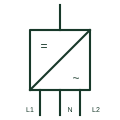
A split-phase inverter produces two AC outputs 180 degrees apart with a shared neutral, giving 120 V from each line to neutral and 240 V between lines. This matches North American residential and small commercial supplies, so the inverter can feed a standard load centre in off-grid or backup systems.
Drawings show the inverter block with three AC output conductors, L1, L2 and N, often with an internal or external autotransformer that balances unequal loads on the two halves. Neutral-earth bonding relays and the generator or grid input are drawn as for other inverter-chargers.
Unequal loading on L1 and L2 must be handled by the inverter or an autotransformer; otherwise one half can overload while the total rating appears adequate. The symbol does not show the per-leg current rating or the bonding arrangement.
A split-phase inverter produces two antiphase legs; a three-phase inverter produces three legs 120 degrees apart.
These public references support the explanation and provide further detail. Their graphics and downloadable files remain with their publishers.
Public split-phase inverter-charger documentation.
Public inverter product listing.
This illustration was authored independently by Elora Grid to explain the concept. It is not reproduced from a customer drawing, an official standard graphic or a manufacturer CAD file. Its correspondence to an exact IEC or IEEE symbol identifier has not been certified.
SVG and DXF downloads contain this original artwork. DXF uses unscaled drawing units; a GA envelope supplies no product dimensions, clearances or fabrication information. Original artwork is available under CC BY 4.0. Third-party references retain their own terms.
A battery converter that charges from an AC source and inverts back to AC, with an internal transfer relay for the load.
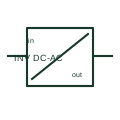
A DC/AC inverter converts a documented DC supply into an AC output.
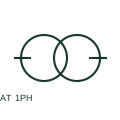
A single-phase autotransformer uses a winding portion shared electrically by its input and output circuits.
Elora Grid helps electrical teams work with drawings, specifications and equipment information. Explore the drafting workflow or join the early-access waitlist.