SVC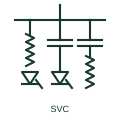
Static var compensator
A shunt reactive power compensator built from thyristor-controlled reactors, thyristor-switched capacitors and filters.
SLD
A voltage-source converter in shunt that injects or absorbs reactive current to support voltage, independent of system voltage.
In plain English
A static synchronous compensator is a voltage-source converter connected in shunt through a reactor or transformer. By controlling the magnitude of its AC output voltage relative to the network, it supplies or absorbs reactive current. It responds within milliseconds and can maintain close to rated current even when network voltage is low.
Drawings show a converter block with a DC capacitor on its DC side, a coupling reactor or transformer, and the connection breaker. Distribution-scale units serving microgrids, wind farms and industrial plants are often drawn as a single converter block labelled STATCOM.
Many STATCOMs can also act as active filters for flicker and harmonics, or be paired with batteries for active power support. The symbol does not show overload capability or which of these functions are enabled.
A voltage-source converter in shunt that injects or absorbs reactive current to support voltage, independent of system voltage. A STATCOM uses a converter and keeps reactive current at low voltage; an SVC uses switched reactances whose output falls with voltage.
Read the source: STATCOM: converter-based reactive power compensation · IEC graphical symbols for diagrams
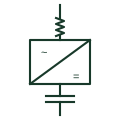
A static synchronous compensator is a voltage-source converter connected in shunt through a reactor or transformer. By controlling the magnitude of its AC output voltage relative to the network, it supplies or absorbs reactive current. It responds within milliseconds and can maintain close to rated current even when network voltage is low.
Drawings show a converter block with a DC capacitor on its DC side, a coupling reactor or transformer, and the connection breaker. Distribution-scale units serving microgrids, wind farms and industrial plants are often drawn as a single converter block labelled STATCOM.
Many STATCOMs can also act as active filters for flicker and harmonics, or be paired with batteries for active power support. The symbol does not show overload capability or which of these functions are enabled.
A STATCOM uses a converter and keeps reactive current at low voltage; an SVC uses switched reactances whose output falls with voltage.
These public references support the explanation and provide further detail. Their graphics and downloadable files remain with their publishers.
Public STATCOM page describing converter-based reactive power support.
IEC graphical symbol context for converters.
This illustration was authored independently by Elora Grid to explain the concept. It is not reproduced from a customer drawing, an official standard graphic or a manufacturer CAD file. Its correspondence to an exact IEC or IEEE symbol identifier has not been certified.
SVG and DXF downloads contain this original artwork. DXF uses unscaled drawing units; a GA envelope supplies no product dimensions, clearances or fabrication information. Original artwork is available under CC BY 4.0. Third-party references retain their own terms.
A shunt reactive power compensator built from thyristor-controlled reactors, thyristor-switched capacitors and filters.
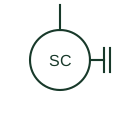
An unloaded synchronous machine on the network that supplies reactive power, inertia and short-circuit strength.
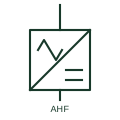
A shunt converter that measures load harmonics and injects opposing currents to cancel them at the connection point.
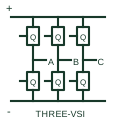
A three-leg bridge producing the documented three-phase output from a DC-link source.
Elora Grid helps electrical teams work with drawings, specifications and equipment information. Explore the drafting workflow or join the early-access waitlist.