MG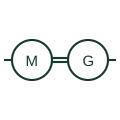
Motor-generator set
A motor mechanically coupled to a generator, used to isolate, change frequency or convert between AC and DC.
SLD / Schematic
A rectifier and inverter in one unit that converts AC at one frequency to AC at another, such as 50 Hz to 60 Hz.
In plain English
A static frequency converter rectifies the incoming AC to DC and inverts it back to AC at a different frequency and often a different voltage. It is used to supply 60 Hz equipment from a 50 Hz network, to provide shore power to ships, to feed 400 Hz aircraft supplies and to link microgrids or networks running at different frequencies.
Drawings show a converter box with AC marks on both sides and the frequencies noted, or two converter boxes back to back with a DC link between them. Input and output transformers are often drawn to provide isolation and voltage matching.
The output is converter-sourced, so fault current is limited and selective protection downstream must be checked. The symbol does not show overload capability or whether the output can supply motor starting current.
A rectifier and inverter in one unit that converts AC at one frequency to AC at another, such as 50 Hz to 60 Hz. A static frequency converter changes frequency electronically; a motor-generator set does the same with rotating machines.
Read the source: IEC graphical symbols for diagrams · Bidirectional three-/single-phase AC/DC PFC and inverter application note
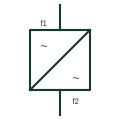
A static frequency converter rectifies the incoming AC to DC and inverts it back to AC at a different frequency and often a different voltage. It is used to supply 60 Hz equipment from a 50 Hz network, to provide shore power to ships, to feed 400 Hz aircraft supplies and to link microgrids or networks running at different frequencies.
Drawings show a converter box with AC marks on both sides and the frequencies noted, or two converter boxes back to back with a DC link between them. Input and output transformers are often drawn to provide isolation and voltage matching.
The output is converter-sourced, so fault current is limited and selective protection downstream must be checked. The symbol does not show overload capability or whether the output can supply motor starting current.
A static frequency converter changes frequency electronically; a motor-generator set does the same with rotating machines.
These public references support the explanation and provide further detail. Their graphics and downloadable files remain with their publishers.
IEC graphical symbol context for converters.
Public AC/DC and inverter stage context.
This illustration was authored independently by Elora Grid to explain the concept. It is not reproduced from a customer drawing, an official standard graphic or a manufacturer CAD file. Its correspondence to an exact IEC or IEEE symbol identifier has not been certified.
SVG and DXF downloads contain this original artwork. DXF uses unscaled drawing units; a GA envelope supplies no product dimensions, clearances or fabrication information. Original artwork is available under CC BY 4.0. Third-party references retain their own terms.
A motor mechanically coupled to a generator, used to isolate, change frequency or convert between AC and DC.
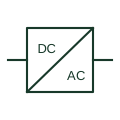
An identified interface converting electrical power between documented circuit forms.
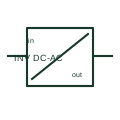
A DC/AC inverter converts a documented DC supply into an AC output.
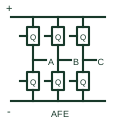
An actively switched AC/DC stage using a documented current-control and DC-link regulation arrangement.
Elora Grid helps electrical teams work with drawings, specifications and equipment information. Explore the drafting workflow or join the early-access waitlist.