BAT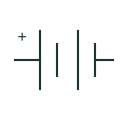
Battery
An electrochemical electrical source or storage element represented in a circuit.
SLD / Schematic
IEEE-style multi-cell battery drawn as alternating long and short plates, with polarity marked, for American drawing sets.
In plain English
In IEEE-style drawing sets a battery is drawn as alternating long and short lines, the long line being positive, with either several plate pairs or two pairs separated by a dashed line to show that cells are omitted. The device designation is commonly BT or B rather than the IEC letter G.
The form appears on station DC schematics, control power drawings and microgrid single-line diagrams in North American projects. This is a convention-specific lookup; the geometry here is independently drawn to explain the connection, and is not a certified reproduction of the standard graphic.
The longer line marks the positive terminal. A dashed gap means additional cells not drawn. The IEEE convention uses BT or B as the device letter; the IEC convention uses G for the same battery concept.
IEEE-style multi-cell battery drawn as alternating long and short plates, with polarity marked, for American drawing sets. The IEEE convention uses BT or B as the device letter; the IEC convention uses G for the same battery concept.
Read the source: IEEE/ANSI 315-1975: graphic symbols for electrical and electronics diagrams · Autodesk IEEE Symbol Preview — Miscellaneous
Form described from IEEE/ANSI 315 drawing practice as publicly summarised; no certified reproduction of the standard graphic is asserted.
Shown as an independently authored educational illustration. Use the cited publication and drawing legend to verify the required drafting form.
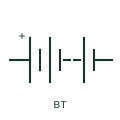
In IEEE-style drawing sets a battery is drawn as alternating long and short lines, the long line being positive, with either several plate pairs or two pairs separated by a dashed line to show that cells are omitted. The device designation is commonly BT or B rather than the IEC letter G.
The form appears on station DC schematics, control power drawings and microgrid single-line diagrams in North American projects. This is a convention-specific lookup; the geometry here is independently drawn to explain the connection, and is not a certified reproduction of the standard graphic.
The IEEE convention uses BT or B as the device letter; the IEC convention uses G for the same battery concept.
These public references support the explanation and provide further detail. Their graphics and downloadable files remain with their publishers.
IEEE/ANSI graphic-symbol standard status and context; not a source of reproduced artwork.
Public IEEE-oriented miscellaneous symbol preview page used for convention context.
This illustration was authored independently by Elora Grid to explain the concept. It is not reproduced from a customer drawing, an official standard graphic or a manufacturer CAD file. Its correspondence to an exact IEC or IEEE symbol identifier has not been certified.
SVG and DXF downloads contain this original artwork. DXF uses unscaled drawing units; a GA envelope supplies no product dimensions, clearances or fabrication information. Original artwork is available under CC BY 4.0. Third-party references retain their own terms.
An electrochemical electrical source or storage element represented in a circuit.
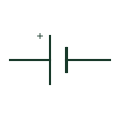
One electrochemical cell drawn as a single long plate and short plate pair, marking cell-level voltage and polarity.
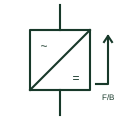
A rectifier charger that holds a stationary battery at float voltage and can apply a higher boost or equalise voltage.
Elora Grid helps electrical teams work with drawings, specifications and equipment information. Explore the drafting workflow or join the early-access waitlist.