PCS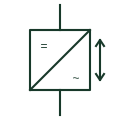
Battery power conversion system
The bidirectional inverter stage of a battery plant that charges and discharges the DC battery from the AC network.
SLD
A complete battery plant block combining batteries, power conversion and controls, shown as one source or sink on an SLD.
In plain English
A battery energy storage system is the full plant: battery racks, a bidirectional power conversion system, transformers, auxiliary supplies and a plant controller. On higher-level single-line diagrams it is shown as one block with a battery mark and a converter mark, connecting to the network through a breaker and often a step-up transformer.
The block is labelled with both power and energy ratings, for example MW and MWh, since the two together define how long the system can deliver rated output. More detailed drawings break the block down into racks, the conversion system and auxiliaries.
The symbol does not show usable energy after depth-of-discharge limits, degradation over life, or whether the converter is grid-forming. These figures, plus the auxiliary load which can be significant for cooling, come from the performance specification.
A complete battery plant block combining batteries, power conversion and controls, shown as one source or sink on an single-line diagram. A BESS block is the complete plant; a battery symbol is only the electrochemical store.
Read the source: Battery energy storage and power conversion · xStorage battery energy storage system
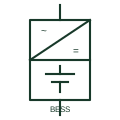
A battery energy storage system is the full plant: battery racks, a bidirectional power conversion system, transformers, auxiliary supplies and a plant controller. On higher-level single-line diagrams it is shown as one block with a battery mark and a converter mark, connecting to the network through a breaker and often a step-up transformer.
The block is labelled with both power and energy ratings, for example MW and MWh, since the two together define how long the system can deliver rated output. More detailed drawings break the block down into racks, the conversion system and auxiliaries.
The symbol does not show usable energy after depth-of-discharge limits, degradation over life, or whether the converter is grid-forming. These figures, plus the auxiliary load which can be significant for cooling, come from the performance specification.
A BESS block is the complete plant; a battery symbol is only the electrochemical store.
These public references support the explanation and provide further detail. Their graphics and downloadable files remain with their publishers.
Public battery energy storage and power conversion context.
Public battery storage system documentation.
This illustration was authored independently by Elora Grid to explain the concept. It is not reproduced from a customer drawing, an official standard graphic or a manufacturer CAD file. Its correspondence to an exact IEC or IEEE symbol identifier has not been certified.
SVG and DXF downloads contain this original artwork. DXF uses unscaled drawing units; a GA envelope supplies no product dimensions, clearances or fabrication information. Original artwork is available under CC BY 4.0. Third-party references retain their own terms.
The bidirectional inverter stage of a battery plant that charges and discharges the DC battery from the AC network.
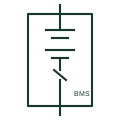
A rack of series-connected battery modules with its own switchgear and battery management unit, forming one DC source.
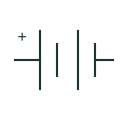
An electrochemical electrical source or storage element represented in a circuit.
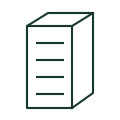
A generic storage-equipment envelope linked to the selected battery system.
Elora Grid helps electrical teams work with drawings, specifications and equipment information. Explore the drafting workflow or join the early-access waitlist.