BOND PE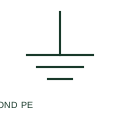
Protective equipotential bonding
Protective equipotential bonding connects documented conductive parts as part of the protective arrangement.
SLD / Schematic
A flexible braid or strap bonding a movable or vibrating metal part, such as a panel door, to the earthing system.
In plain English
A bonding strap connects metal parts that cannot be bonded with rigid conductors, such as hinged doors carrying equipment, gland plates, cable tray across expansion joints and equipment on anti-vibration mounts. Braided straps also provide low impedance at high frequency, which helps with EMC bonding in drive panels.
The symbol does not state cross-sectional area or length, both of which affect protective and high-frequency performance. A long thin strap may satisfy continuity tests but give poor EMC performance. Painted surfaces under strap lugs must be cleaned for a reliable connection.
Check strap size against the protective conductor rule. Look for EMC bonding requirements in drive panels. A bonding strap is a flexible protective or EMC bond; a flexible conductor is a circuit conductor that must flex in service.
A flexible braid or strap bonding a movable or vibrating metal part, such as a panel door, to the earthing system. A bonding strap is a flexible protective or EMC bond; a flexible conductor is a circuit conductor that must flex in service.
Read the source: Earthing connections · AutoCAD Electrical: Earthing, sources and surge protection

A bonding strap connects metal parts that cannot be bonded with rigid conductors, such as hinged doors carrying equipment, gland plates, cable tray across expansion joints and equipment on anti-vibration mounts. Braided straps also provide low impedance at high frequency, which helps with EMC bonding in drive panels.
The symbol does not state cross-sectional area or length, both of which affect protective and high-frequency performance. A long thin strap may satisfy continuity tests but give poor EMC performance. Painted surfaces under strap lugs must be cleaned for a reliable connection.
A bonding strap is a flexible protective or EMC bond; a flexible conductor is a circuit conductor that must flex in service.
These public references support the explanation and provide further detail. Their graphics and downloadable files remain with their publishers.
Public installation-guide earthing and equipotential connection elements.
Public IEC-oriented bonding forms.
This illustration was authored independently by Elora Grid to explain the concept. It is not reproduced from a customer drawing, an official standard graphic or a manufacturer CAD file. Its correspondence to an exact IEC or IEEE symbol identifier has not been certified.
SVG and DXF downloads contain this original artwork. DXF uses unscaled drawing units; a GA envelope supplies no product dimensions, clearances or fabrication information. Original artwork is available under CC BY 4.0. Third-party references retain their own terms.
Protective equipotential bonding connects documented conductive parts as part of the protective arrangement.

A wavy conductor line showing a connection that must flex, such as a lead to moving equipment or a vibration break.

A connection to the metal frame or chassis of equipment, which may or may not itself be connected to earth.
Elora Grid helps electrical teams work with drawings, specifications and equipment information. Explore the drafting workflow or join the early-access waitlist.