RAM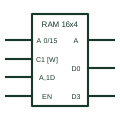
IEC random-access memory (RAM)
IEC element marked RAM with address grouping, a write control input and A-labelled data inputs and outputs.
IEC
Dependency label A used on memory symbols to show which word of an array the address inputs select.
In plain English
A dependency is used mainly on memory symbols. Address inputs are grouped, often with the binary grouping symbol, to produce internal affecting inputs A0 to An. Data inputs and outputs labelled A then act only on the selected word, so one symbol can represent an entire array.
Reading a memory symbol, start with the address grouping to see the range, then follow the A-labelled data terminals. TI's public overview shows an array of latches forming a small random-access memory using this method.
The notation does not give access time or organisation details beyond word count and width. Those are in the device data.
Dependency label A used on memory symbols to show which word of an array the address inputs select. M dependency selects modes, while A selects which of several identical words is accessed.
Read the source: Overview of IEEE Standard 91-1984: explanation of logic symbols (SDYZ001A)
Qualifying-symbol and dependency conventions as explained in TI's public overview of IEEE Std 91-1984, which incorporates IEC 617-12 work. Independent educational drawing; not certified IEC geometry or an IEC database identifier.
Shown as an independently authored educational illustration. Use the cited publication and drawing legend to verify the required drafting form.
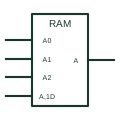
A dependency is used mainly on memory symbols. Address inputs are grouped, often with the binary grouping symbol, to produce internal affecting inputs A0 to An. Data inputs and outputs labelled A then act only on the selected word, so one symbol can represent an entire array.
Reading a memory symbol, start with the address grouping to see the range, then follow the A-labelled data terminals. TI's public overview shows an array of latches forming a small random-access memory using this method.
The notation does not give access time or organisation details beyond word count and width. Those are in the device data.
M dependency selects modes, while A selects which of several identical words is accessed.
These public references support the explanation and provide further detail. Their graphics and downloadable files remain with their publishers.
A (address) dependency and memory array examples.
This illustration was authored independently by Elora Grid to explain the concept. It is not reproduced from a customer drawing, an official standard graphic or a manufacturer CAD file. Its correspondence to an exact IEC or IEEE symbol identifier has not been certified.
SVG and DXF downloads contain this original artwork. DXF uses unscaled drawing units; a GA envelope supplies no product dimensions, clearances or fabrication information. Original artwork is available under CC BY 4.0. Third-party references retain their own terms.
IEC element marked RAM with address grouping, a write control input and A-labelled data inputs and outputs.
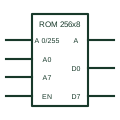
IEC element marked ROM with grouped address inputs and data outputs that read the addressed word.
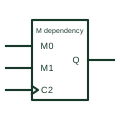
Dependency label Mm used to show operating modes; affected inputs and outputs act only in the selected mode.
Elora Grid helps electrical teams work with drawings, specifications and equipment information. Explore the drafting workflow or join the early-access waitlist.