W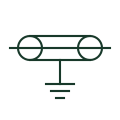
Coaxial cable with earthed outer conductor
A coaxial cable whose outer conductor is drawn connected to earth, recording the reference point of the RF or signal return.
IEC
A centre conductor drawn within a concentric outer conductor, used for RF, video and some high-frequency measurement leads.
In plain English
The coaxial cable symbol shows an inner conductor surrounded by a concentric outer conductor that forms the return path. Unlike a screened conductor, the outer conductor of a coaxial cable is part of the signal circuit and sets a defined characteristic impedance. It appears on antenna feeds, GPS time-sync leads to protection relays, video circuits and some partial-discharge sensor connections.
The symbol does not give the impedance, attenuation or connector type. A 50 ohm and a 75 ohm cable look identical on the drawing, so the cable schedule must identify the type. Where the outer conductor is earthed, show that separately rather than assuming the reader knows the earthing arrangement.
Check the cable type and impedance against the equipment at both ends. Look for connector designations at each end of the coax run. In coaxial cable the outer conductor carries return current; in a screened conductor the screen only intercepts interference.
A centre conductor drawn within a concentric outer conductor, used for RF, video and some high-frequency measurement leads. In coaxial cable the outer conductor carries return current; in a screened conductor the screen only intercepts interference.
Read the source: IEC-60617 symbol preview directory · IEEE/ANSI 315-1975: graphic symbols for electrical and electronics diagrams
Independent IEC-context illustration of a concentric pair; consult IEC 60617 for the exact graphic.
Shown as an independently authored educational illustration. Use the cited publication and drawing legend to verify the required drafting form.
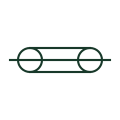
The coaxial cable symbol shows an inner conductor surrounded by a concentric outer conductor that forms the return path. Unlike a screened conductor, the outer conductor of a coaxial cable is part of the signal circuit and sets a defined characteristic impedance. It appears on antenna feeds, GPS time-sync leads to protection relays, video circuits and some partial-discharge sensor connections.
The symbol does not give the impedance, attenuation or connector type. A 50 ohm and a 75 ohm cable look identical on the drawing, so the cable schedule must identify the type. Where the outer conductor is earthed, show that separately rather than assuming the reader knows the earthing arrangement.
In coaxial cable the outer conductor carries return current; in a screened conductor the screen only intercepts interference.
These public references support the explanation and provide further detail. Their graphics and downloadable files remain with their publishers.
Public directory of IEC-oriented symbol families.
Standards context for coaxial conductor graphics in IEEE forms.
This illustration was authored independently by Elora Grid to explain the concept. It is not reproduced from a customer drawing, an official standard graphic or a manufacturer CAD file. Its correspondence to an exact IEC or IEEE symbol identifier has not been certified.
SVG and DXF downloads contain this original artwork. DXF uses unscaled drawing units; a GA envelope supplies no product dimensions, clearances or fabrication information. Original artwork is available under CC BY 4.0. Third-party references retain their own terms.
A coaxial cable whose outer conductor is drawn connected to earth, recording the reference point of the RF or signal return.

A plug and socket pair with concentric inner and outer contacts, used to connect coaxial cables to equipment.
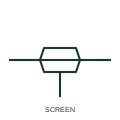
A single conductor enclosed by a drawn screen outline, showing that the core has a conductive shield around it.
Elora Grid helps electrical teams work with drawings, specifications and equipment information. Explore the drafting workflow or join the early-access waitlist.