WIND STN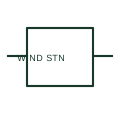
Wind generating station
A wind generating station is a system-level representation of a documented wind-generation facility.
SLD / Schematic
A wind turbine whose squirrel-cage induction generator connects to the network directly, running at nearly constant speed.
In plain English
This symbol marks a Type 1 wind turbine: a rotor-driven squirrel-cage induction generator whose stator connects to the collector network through a soft starter and a step-up transformer, with no power converter in the main path. Speed varies only by the generator slip, typically one or two per cent, so the turbine is described as fixed-speed.
On a single-line diagram it is usually drawn as a blade or rotor glyph coupled to a generator circle marked for an induction machine, followed by the soft starter, switched capacitor steps for reactive power and the pad-mount or nacelle transformer. Older wind farms and small community turbines are the main places it still appears.
The symbol does not state the reactive demand of the generator, the capacitor step sizes or how the turbine behaves during voltage dips. Those values come from the turbine data sheet and the grid connection study, because an induction generator draws magnetising current from the network rather than supplying it.
A wind turbine whose squirrel-cage induction generator connects to the network directly, running at nearly constant speed. A Type 1 turbine has no converter in the power path; a Type 3 or Type 4 turbine shows a converter that sets speed and reactive output.
Read the source: AutoCAD Electrical: Power station and substation concepts · IEEE/ANSI 315-1975: graphic symbols for electrical and electronics diagrams
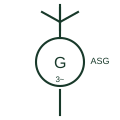
This symbol marks a Type 1 wind turbine: a rotor-driven squirrel-cage induction generator whose stator connects to the collector network through a soft starter and a step-up transformer, with no power converter in the main path. Speed varies only by the generator slip, typically one or two per cent, so the turbine is described as fixed-speed.
On a single-line diagram it is usually drawn as a blade or rotor glyph coupled to a generator circle marked for an induction machine, followed by the soft starter, switched capacitor steps for reactive power and the pad-mount or nacelle transformer. Older wind farms and small community turbines are the main places it still appears.
The symbol does not state the reactive demand of the generator, the capacitor step sizes or how the turbine behaves during voltage dips. Those values come from the turbine data sheet and the grid connection study, because an induction generator draws magnetising current from the network rather than supplying it.
A Type 1 turbine has no converter in the power path; a Type 3 or Type 4 turbine shows a converter that sets speed and reactive output.
These public references support the explanation and provide further detail. Their graphics and downloadable files remain with their publishers.
Public wind generating station representation used as the site-level context for turbine symbols.
Graphic-symbol standards context for rotating machines; no reproduced artwork.
This illustration was authored independently by Elora Grid to explain the concept. It is not reproduced from a customer drawing, an official standard graphic or a manufacturer CAD file. Its correspondence to an exact IEC or IEEE symbol identifier has not been certified.
SVG and DXF downloads contain this original artwork. DXF uses unscaled drawing units; a GA envelope supplies no product dimensions, clearances or fabrication information. Original artwork is available under CC BY 4.0. Third-party references retain their own terms.
A wind generating station is a system-level representation of a documented wind-generation facility.
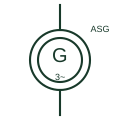
A squirrel-cage asynchronous machine driven above synchronous speed so that it delivers power into a three-phase network.
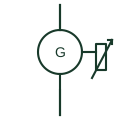
A wind turbine using a wound-rotor induction generator with controlled external rotor resistance to widen the slip range.
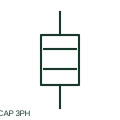
A three-phase capacitor assembly provides a documented reactive-power function connected to the power circuit.
Elora Grid helps electrical teams work with drawings, specifications and equipment information. Explore the drafting workflow or join the early-access waitlist.