EN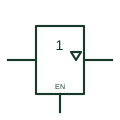
IEC three-state buffer (rectangular form)
IEC buffer whose output carries the three-state triangle and is controlled by an EN input.
IEC
Downward triangle inside an outline marking an output that can enter a high-impedance state.
In plain English
The three-state additional drawing mark is a small triangle pointing downwards, drawn inside the outline next to the output. It says the output has a third, high-impedance state in addition to high and low. The output is controlled by an EN input or by EN dependency.
Wherever this additional drawing mark appears, the reader should find the controlling EN input and confirm that only one driver on the net can be enabled at once. On bus diagrams the additional drawing mark is often shown on only the first element of an array to reduce clutter.
The additional drawing mark does not indicate bus hold or default level when all drivers are off. A floating bus needs pull resistors or bus-keeper circuitry shown separately.
Downward triangle inside an outline marking an output that can enter a high-impedance state. The open-circuit diamond indicates a stage that is off in one level, not a controlled high-impedance state.
Read the source: Overview of IEEE Standard 91-1984: explanation of logic symbols (SDYZ001A)
Qualifying-symbol and dependency conventions as explained in TI's public overview of IEEE Std 91-1984, which incorporates IEC 617-12 work. Independent educational drawing; not certified IEC geometry or an IEC database identifier.
Shown as an independently authored educational illustration. Use the cited publication and drawing legend to verify the required drafting form.
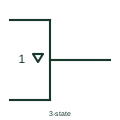
The three-state qualifier is a small triangle pointing downwards, drawn inside the outline next to the output. It says the output has a third, high-impedance state in addition to high and low. The output is controlled by an EN input or by EN dependency.
Wherever this qualifier appears, the reader should find the controlling EN input and confirm that only one driver on the net can be enabled at once. On bus diagrams the qualifier is often shown on only the first element of an array to reduce clutter.
The qualifier does not indicate bus hold or default level when all drivers are off. A floating bus needs pull resistors or bus-keeper circuitry shown separately.
The open-circuit diamond indicates a stage that is off in one level, not a controlled high-impedance state.
These public references support the explanation and provide further detail. Their graphics and downloadable files remain with their publishers.
Defines the three-state output qualifier and EN effects.
This illustration was authored independently by Elora Grid to explain the concept. It is not reproduced from a customer drawing, an official standard graphic or a manufacturer CAD file. Its correspondence to an exact IEC or IEEE symbol identifier has not been certified.
SVG and DXF downloads contain this original artwork. DXF uses unscaled drawing units; a GA envelope supplies no product dimensions, clearances or fabrication information. Original artwork is available under CC BY 4.0. Third-party references retain their own terms.
IEC buffer whose output carries the three-state triangle and is controlled by an EN input.
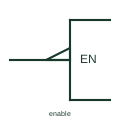
Input labelled EN that enables all outputs of the element when at its internal 1 state.
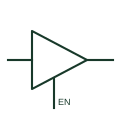
A digital output stage that can drive logical states or enter its documented high-impedance state.
Elora Grid helps electrical teams work with drawings, specifications and equipment information. Explore the drafting workflow or join the early-access waitlist.