25
Synchronism check
Checks documented synchronising conditions before a permitted connection.
Protection functions
An independently authored application reference. The drawing shows the named function or circuit relationship; use the project legend and selected equipment documentation for its drafting form and connections.
Browse this installation focusIn plain English
Withdraws the defined synchronising request when its authorized cancellation condition occurs.
In a microgrid reconnecting at its point of common coupling, a synchroniser can adjust the island reference while a separate permissive confirms the permitted relationship across the open breaker. For this reference, the drawing identifies “Cancel request or lost prerequisite” at the input and “Synchronization cancellation” at the output. Completed breaker movement cannot be cancelled retrospectively.
Start at the named input: Cancel request or lost prerequisite. Identify its source device or document and the state represented on the drawing. Follow the named output: Synchronization cancellation. Cross-reference its destination and separate the command from confirmation that the equipment responded.
Read the source: Microgrid Flex components and control design
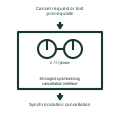
Withdraws the defined synchronising request when its authorized cancellation condition occurs. Synchronising control compares two AC systems before their assigned connecting breaker closes. Voltage magnitude, frequency, phase relationship, breaker readiness and command authority are separate inputs to the closing decision.
In a microgrid reconnecting at its point of common coupling, a synchroniser can adjust the island reference while a separate permissive confirms the permitted relationship across the open breaker. For this reference, the drawing identifies “Cancel request or lost prerequisite” at the input and “Synchronization cancellation” at the output. Completed breaker movement cannot be cancelled retrospectively.
Identify the two measurement sides and the equipment receiving any adjustment request. Closing limits, breaker timing and loss-of-measurement behavior require the approved synchronising design. The functional block is an independent explanation of this named application. Equipment-specific ratings, terminal connections and operating conditions must be established in the project documentation.
Completed breaker movement cannot be cancelled retrospectively. This reference describes the named application; it does not establish a new IEC graphical symbol, an ANSI device-function number or an exact manufacturer connection diagram.
These public references support the explanation and provide further detail. Their graphics and downloadable files remain with their publishers.
Public technical context for microgrid synchronising interfaces. Microgrid power and control interfaces, synchronisation and source coordination. The application text and educational graphic are independently authored; the publisher does not certify this representation.
This illustration was authored independently by Elora Grid to explain the concept. It is not reproduced from a customer drawing, an official standard graphic or a manufacturer CAD file. Its correspondence to an exact IEC or IEEE symbol identifier has not been certified.
SVG and DXF downloads contain this original artwork. Original artwork is available under CC BY 4.0. Third-party references retain their own terms.
Checks documented synchronising conditions before a permitted connection.
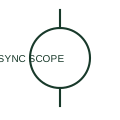
A synchronoscope indicates the phase relationship and relative frequency behaviour of two AC sources.
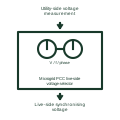
Identifies the utility-side voltage reference supplied to the PCC synchronising function.
Elora Grid helps electrical teams work with drawings, specifications and equipment information. Explore the drafting workflow or join the early-access waitlist.