27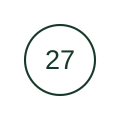
Undervoltage
A function responding to voltage below its configured operating criteria.
Protection functions
A function responding to a documented frequency condition.
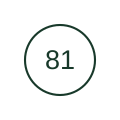
Frequency protection responds to frequency conditions according to the selected implementation. Underfrequency, overfrequency and rate-of-change functions can be distinguished by additional suffixes and device documentation. A generic 81 reference does not determine which variant is applied.
On a power drawing, keep this function reference connected to the selected equipment and its complete designation. A multifunction relay can implement several numbered functions. This entry explains the reference; it supplies no settings or commissioning procedure.
Underfrequency, overfrequency and rate-of-change are different functions even when their designations share the number 81.
These public references support the explanation and provide further detail. Their graphics and downloadable files remain with their publishers.
Public manufacturer table used to check the base function-number name.
Normative publication reference for the device-function convention.
Public examples of manufacturer-specific function names and suffixes.
This illustration was authored independently by Elora Grid to explain the concept. It is not reproduced from a customer drawing, an official standard graphic or a manufacturer CAD file. Its correspondence to an exact IEC or IEEE symbol identifier has not been certified.
SVG and DXF downloads contain this original artwork. DXF uses unscaled drawing units; a GA envelope supplies no product dimensions, clearances or fabrication information. Original artwork is available under CC BY 4.0. Third-party references retain their own terms.
A function responding to voltage below its configured operating criteria.

An electrical generating source represented in a power-system drawing.
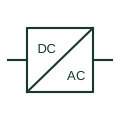
An identified interface converting electrical power between documented circuit forms.
Elora Grid helps electrical teams work with drawings, specifications and equipment information. Explore the drafting workflow or join the early-access waitlist.