SOE
Sequence-of-events recorder
Recorder that timestamps changes of state on many binary inputs so the order of operations can be reconstructed.
Schematic
An independently authored application reference. The drawing shows the named function or circuit relationship; use the project legend and selected equipment documentation for its drafting form and connections.
Browse this installation focusIn plain English
Shows the station network time service used by the assigned supervisory devices.
In a substation, a station clock can provide precision timing to process equipment and another timing interface to event recorders. The alarm system should distinguish loss of a distribution path from loss of the external time source. For this reference, the drawing identifies “Station time server” at the input and “NTP client time reference” at the output. NTP suitability depends on the required timing performance.
Start at the named input: Station time server. Identify its source device or document and the state represented on the drawing. Follow the named output: NTP client time reference. Cross-reference its destination and separate the command from confirmation that the equipment responded.
Read the source: SEL-2488 satellite-synchronised network clock
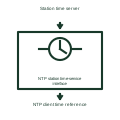
Shows the station network time service used by the assigned supervisory devices. A station time system provides a shared time reference for protection records, measurements and automation. Different devices can use different timing protocols, so the time source, distribution path and quality information must remain identifiable.
In a substation, a station clock can provide precision timing to process equipment and another timing interface to event recorders. The alarm system should distinguish loss of a distribution path from loss of the external time source. For this reference, the drawing identifies “Station time server” at the input and “NTP client time reference” at the output. NTP suitability depends on the required timing performance.
Show the source and client of each time connection. Required accuracy, holdover, protocol profile and loss-of-time behavior follow the selected application; a common timestamp format does not guarantee synchronized events. The functional block is an independent explanation of this named application. Equipment-specific ratings, terminal connections and operating conditions must be established in the project documentation.
NTP suitability depends on the required timing performance. This reference describes the named application; it does not establish a new IEC graphical symbol, an ANSI device-function number or an exact manufacturer connection diagram.
These public references support the explanation and provide further detail. Their graphics and downloadable files remain with their publishers.
Public technical context for substation timing and event interfaces. PTP, NTP, IRIG-B, pulse distribution, reference failover and timing quality. The application text and educational graphic are independently authored; the publisher does not certify this representation.
This illustration was authored independently by Elora Grid to explain the concept. It is not reproduced from a customer drawing, an official standard graphic or a manufacturer CAD file. Its correspondence to an exact IEC or IEEE symbol identifier has not been certified.
SVG and DXF downloads contain this original artwork. Original artwork is available under CC BY 4.0. Third-party references retain their own terms.
Recorder that timestamps changes of state on many binary inputs so the order of operations can be reconstructed.

Device that measures voltage and current phasors with precise time stamps so angles can be compared across a network.
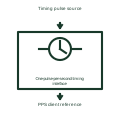
Identifies the pulse timing connection associated with the selected time equipment.
Elora Grid helps electrical teams work with drawings, specifications and equipment information. Explore the drafting workflow or join the early-access waitlist.