R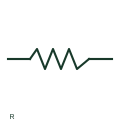
ANSI/IEEE resistor symbol
IEEE-oriented graphical reference for resistor, with public vendor evidence and drawing-reading notes.
IEEE / ANSI
Passive components, semiconductor devices and electronic elements used in power conversion, sensing and control schematics. Explore 55 references, with original explanations and public primary sources.
IEEE-oriented graphical reference for resistor, with public vendor evidence and drawing-reading notes.
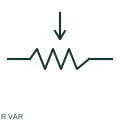
IEEE-oriented graphical reference for variable resistor, with public vendor evidence and drawing-reading notes.
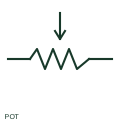
IEEE-oriented graphical reference for potentiometer, with public vendor evidence and drawing-reading notes.
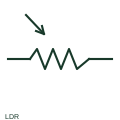
IEEE-oriented graphical reference for light-dependent resistor, with public vendor evidence and drawing-reading notes.
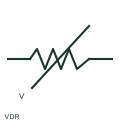
IEEE-oriented graphical reference for varistor, with public vendor evidence and drawing-reading notes.
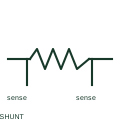
IEEE-oriented graphical reference for current-measuring shunt, with public vendor evidence and drawing-reading notes.
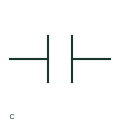
IEEE-oriented graphical reference for capacitor, with public vendor evidence and drawing-reading notes.
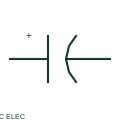
IEEE-oriented graphical reference for electrolytic capacitor, with public vendor evidence and drawing-reading notes.
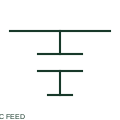
IEEE-oriented graphical reference for feedthrough capacitor, with public vendor evidence and drawing-reading notes.
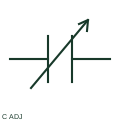
IEEE-oriented graphical reference for adjustable capacitor, with public vendor evidence and drawing-reading notes.
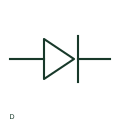
IEEE-oriented graphical reference for diode, with public vendor evidence and drawing-reading notes.
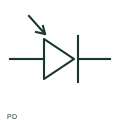
IEEE-oriented graphical reference for photodiode, with public vendor evidence and drawing-reading notes.
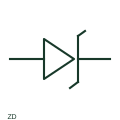
IEEE-oriented graphical reference for zener diode, with public vendor evidence and drawing-reading notes.
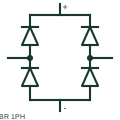
IEEE-oriented graphical reference for single-phase bridge rectifier, with public vendor evidence and drawing-reading notes.
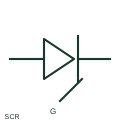
IEEE-oriented graphical reference for silicon-controlled rectifier, with public vendor evidence and drawing-reading notes.
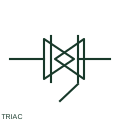
IEEE-oriented graphical reference for triac, with public vendor evidence and drawing-reading notes.
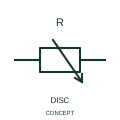
This form distinguishes a movable resistor contact with a disconnecting position.
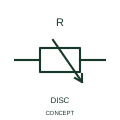
This representation identifies the publisher's carbon-disc variable-resistance form.
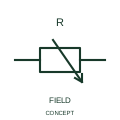
This representation identifies a resistive element whose response is associated with a magnetic field.
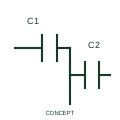
This representation distinguishes a differential capacitive arrangement with related variable capacitances.
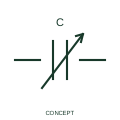
This form distinguishes a capacitor with a preset or trim adjustment.
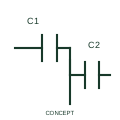
This representation distinguishes the publisher's split and adjustable capacitor form.
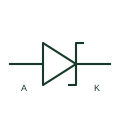
A metal-semiconductor diode used for rectification or clamping with device-specific forward and reverse characteristics.
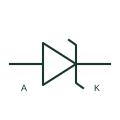
A transient-suppression diode intended to clamp a documented surge polarity across a protected circuit.
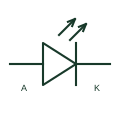
A semiconductor diode that emits light when operated with the appropriate forward current.
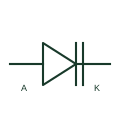
A reverse-biased diode whose junction capacitance is used as a voltage-controlled circuit element.
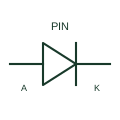
A diode structure used in applications such as RF switching or attenuation with a documented bias circuit.
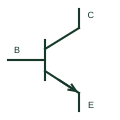
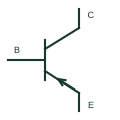
A bipolar transistor with base, collector and emitter terminals arranged for NPN operation.
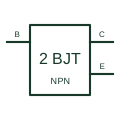
A bipolar transistor with base, collector and emitter terminals arranged for PNP operation.
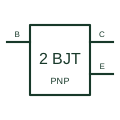
Two NPN transistor stages connected as a Darlington pair to provide a combined current-amplifying device.
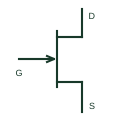
Two PNP transistor stages connected as a compound current-amplifying device.
A junction field-effect transistor using an N-type channel controlled through a gate junction.
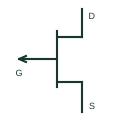
A junction field-effect transistor using a P-type channel and the corresponding gate-bias polarity.
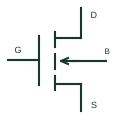
An insulated-gate transistor whose N-channel conduction is enabled by the documented gate-to-source drive.
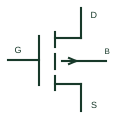
An insulated-gate transistor using a P-channel and the corresponding gate-to-source drive polarity.
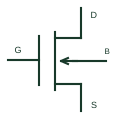
An N-channel insulated-gate device that conducts at zero gate-to-source voltage according to its device characteristics.
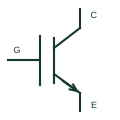
A power transistor combining insulated-gate control with a bipolar collector-emitter conduction structure.
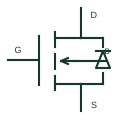
The intrinsic diode associated with a MOSFET's semiconductor structure, often shown within the device reference.
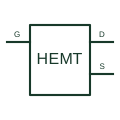
A normally-off gallium-nitride high-electron-mobility transistor used as a controlled power switch.
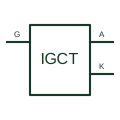
A high-power thyristor device operated with an integrated gate-unit arrangement for controlled switching.
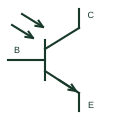
An NPN transistor whose collector-emitter conduction responds to incident light in the documented detector arrangement.
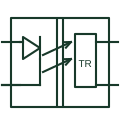
An optical isolation component using an input light emitter and a transistor output on the isolated side.
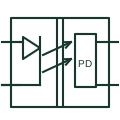
An optically coupled component using photodiode output sensing for an isolation or feedback arrangement.
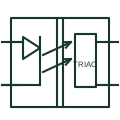
An optical isolation device whose output is a light-triggered triac-type switching element.
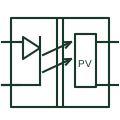
An optical component producing an isolated photovoltaic output used to drive a MOSFET gate circuit.
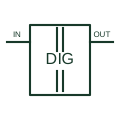
Transfers digital information between separately referenced electrical domains through a capacitive isolation structure.
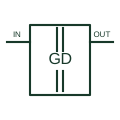
Transfers a switching command across an isolation barrier and drives a power-transistor gate circuit.
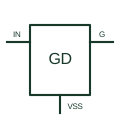
Provides gate-drive current for a power switch referenced to the driver's low-side return.
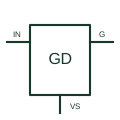
Drives a high-side power transistor with the output circuit referenced to its switching node.
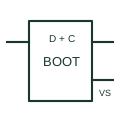
A diode-capacitor arrangement used to supply a floating high-side gate-driver circuit under documented switching conditions.
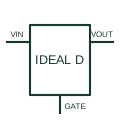
Controls an external transistor to obtain the documented low-loss directional or reverse-blocking power path.
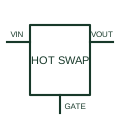
Controls a power path during equipment insertion or power-up to manage the documented inrush sequence.
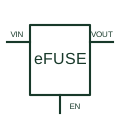
An integrated semiconductor power-path device providing the selected current-limiting and protection functions.
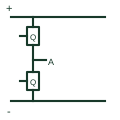
A packaged power-switch arrangement forming one half-bridge switching leg.
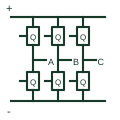
A power module containing three switching legs for a three-phase bridge arrangement.